
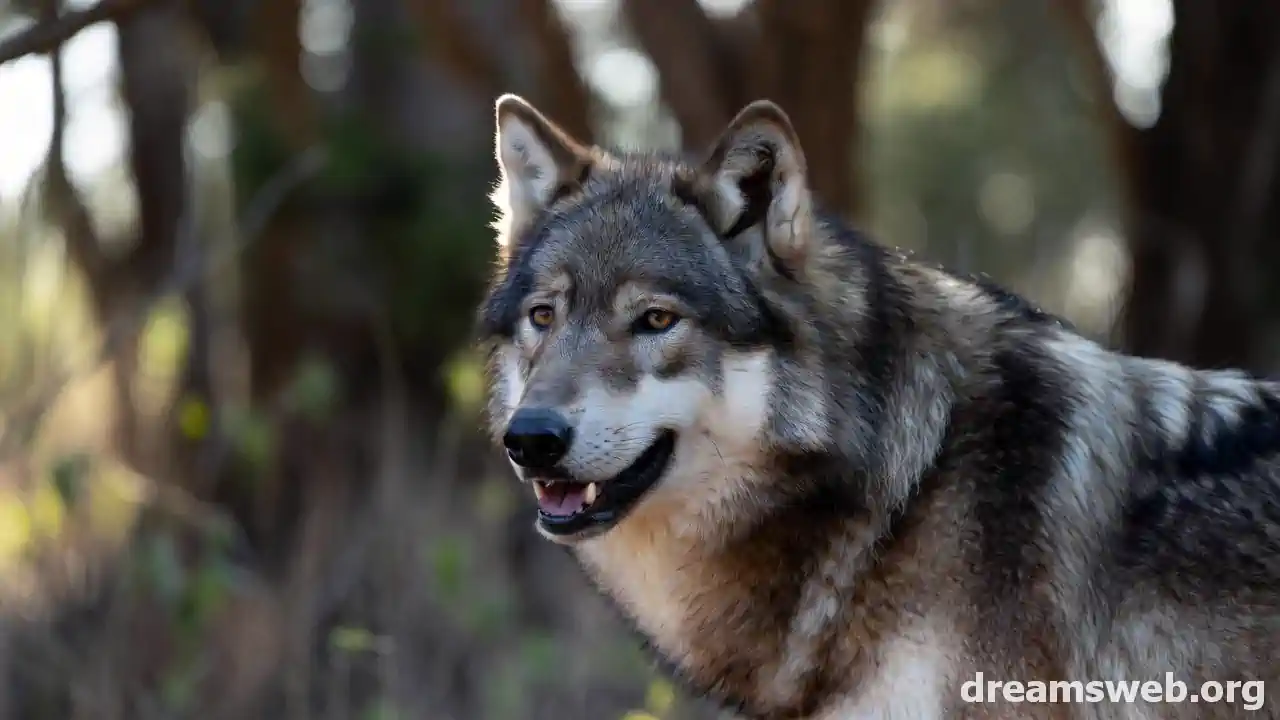
The wolf is one of the most spiritually loaded animals in the entire dreamscape. It appears across indigenous traditions, shamanic cosmologies, Jungian psychology, and religious symbolism — almost always as a creature of immense inner power. But when that wolf is friendly — when it approaches you with calm, sits beside you, or guides you without threat — the spiritual message shifts into something altogether different. Something worth sitting with.
This article unpacks the dream of friendly wolf spiritual meaning from multiple angles: psychological, cultural, metaphysical, and deeply personal. Whether you’ve had this dream once or it keeps returning, the interpretation ahead is designed to help you listen more carefully to what your inner world is quietly communicating.
—What Does a Friendly Wolf Represent Spiritually?
In most spiritual traditions, the wolf is neither a simple predator nor a simple guardian. It occupies a luminous middle space — a creature of raw instinct that also moves in packs, that howls at the moon, that navigates the darkness with extraordinary precision. Spiritually, this makes the wolf a symbol of integrated duality: shadow and light, independence and community, primal wisdom and social grace.
When the wolf in your dream is friendly, that duality resolves into something harmonious. The dream of friendly wolf spiritual meaning often points to the emergence of an inner guide — a part of yourself that has moved through the wilderness and returned not as threat, but as ally.
In shamanic frameworks, which predate most formal religions, the wolf is one of the most honored power animals. Encountering it peacefully in a dream is considered a visitation — an invitation to claim your own instinctual authority. You are being told, in essence: your instincts are trustworthy. Your wildness is not something to fear.
Spiritually, this dream may also signal a period of transformation. The wolf walks between worlds — the domesticated and the untamed, the known and the unknowable. Dreaming of it in a friendly form suggests you may be on the threshold of something new, and that this transition is protected rather than perilous.
Pause for a moment: When the wolf appeared in your dream, did it feel like a reunion — as if you already knew each other?
—Top Symbols Hidden in Your Friendly Wolf Dream
Dreams rarely arrive as simple images. They layer symbols the way a river layers sediment — quietly, and with great depth. A dream of a friendly wolf carries several distinct symbolic registers worth examining:
The Wolf as Psychopomp
In older mythologies — Norse, Celtic, and indigenous North American — the wolf served as a psychopomp, a guide of souls between realms. A friendly wolf in your dream may not be guiding you to death in the literal sense, but it could be escorting you across an inner threshold: from fear to trust, from grief to acceptance, from confusion to clarity. The warmth of its presence signals that the crossing is safe.
Eye Contact and Mutual Recognition
If the wolf looked at you directly in the dream — held your gaze — this is a potent symbol of recognition. In lupine communication, sustained eye contact between equals is a form of acknowledgment. Spiritually, it may mean that a deeper part of yourself is finally being seen, or that a guide, ancestor, or divine presence is making itself known to you. You are not invisible. You are witnessed.
Touch and Physical Closeness
Did the wolf press its flank against you? Allow you to touch it? Physical closeness in a friendly wolf dream symbolizes spiritual intimacy — a merging of your conscious self with your wilder, instinctual nature. This is particularly significant if you have spent time in your waking life suppressing your true feelings, your intuition, or your authentic desires. The wolf is leaning in. Are you ready to lean back?
The Color of the Wolf
A grey wolf typically represents wisdom, balance, and neutral power. A white wolf amplifies the spiritual dimension — purity, clairvoyance, and divine alignment. A black wolf, even when friendly, carries the energy of shadow integration — acknowledging the parts of yourself that have lived in darkness, and finding they are not dangerous after all. Each hue deepens the dream of friendly wolf spiritual meaning in its own specific way.
The Wolf’s Movement
Was it still, or was it leading you somewhere? A stationary wolf often invites contemplation — it is asking you to stop and be present. A walking or running wolf that moves with you is a symbol of momentum, of spiritual journeying in motion. You are not stuck. You are being guided forward.
—Is a Friendly Wolf Dream a Sign From the Universe?
Many people who experience a dream of friendly wolf spiritual meaning describe it as one of those rare dreams that doesn’t feel like ordinary sleep — it feels like contact. Vivid. Emotionally resonant. Sometimes accompanied by a peculiar sensation of warmth or calm that persists long into the waking day.
Whether you hold a religious framework, a metaphysical one, or a purely psychological one, it’s worth taking that felt sense seriously. Dreams that carry this quality of luminance — what depth psychologists call numinous dreams — are generally understood to carry messages from the deeper self or, depending on your belief system, from something beyond the individual self entirely.
In many indigenous traditions, dream animals are not merely symbols but actual spiritual emissaries. The Lakota people, for instance, hold the wolf in deep reverence as a teacher of intuition and family loyalty. To dream of one approaching peacefully is considered a significant omen — not a random neurological event, but a communication worthy of ceremony and reflection.
From a Jungian psychological angle, the friendly wolf may represent a long-suppressed archetype that is now safe enough to emerge. Carl Jung wrote extensively about the way the unconscious communicates through animal imagery, often when the psyche is ready to integrate something new. The wolf’s friendliness, in this reading, is your own unconscious signaling: I am no longer a threat. It is safe to know me.
So is it a sign from the universe? Perhaps the more honest question is: what would shift in your life if you treated it as one?
—Friendly Wolf Dreams Across Cultures and Religions
The symbolism of the wolf is strikingly consistent across the world’s mythological and spiritual traditions, even in cultures that never had contact with one another. That cross-cultural resonance suggests the wolf touches something deep and universal in the human psyche.
Norse Mythology
In Norse tradition, wolves occupy a complex divine space. Fenrir is fearsome, but Odin’s wolves — Geri and Freki — are companions of wisdom and war. To dream of a friendly wolf in this symbolic lineage speaks of alignment with the Allfather’s deeper knowledge: strategic, unflinching, and ultimately wise. The wolf here is a keeper of cosmic secrets.
Native American Traditions
Across many First Nations peoples, the wolf is a sacred teacher. Among the Cherokee, the wolf clan is one of the seven original clans — associated with warfare, protection, and spiritual leadership. Among the Anishinaabe, wolf medicine is closely related to the moon and to one’s personal path of purpose. A friendly wolf dream in these traditions signals that you are walking in alignment with your true path, miini-bimaatizi — living well according to your nature.
Celtic Spirituality
The Celts honored the wolf as a creature of the wild divine — of the forest, the liminal, and the untameable aspects of nature that humans must respect rather than conquer. A friendly wolf in Celtic dream symbolism suggests the wild world is offering you its trust. That is not given lightly. It means your spirit is recognized as one that can walk in both cultivated and untamed places.
Christianity and Abrahamic Traditions
The wolf in biblical literature is often adversarial — wolves in sheep’s clothing, wolves threatening the flock. However, the prophet Isaiah envisions a messianic age where the wolf lies down with the lamb — a symbol of profound reconciliation. A friendly wolf dream within a Christian spiritual lens might carry that prophetic weight: an era of personal peace is approaching. Conflict within yourself is resolving.
Similar to how the fox dream meaning draws from both European and Asian traditions to reveal messages about wisdom and adaptability, the wolf dream taps into a vast global archive of spiritual symbolism — each tradition adding texture and nuance to its meaning.
—Common Friendly Wolf Dream Scenarios Fully Explained
Not all friendly wolf dreams unfold the same way. The specific scenario in which the wolf appears offers additional layers of interpretation. Here are the most common encounters and what they may suggest:
The Wolf That Walks Beside You
This is perhaps the most common form of the dream of friendly wolf spiritual meaning. You are walking a path — sometimes familiar, sometimes strange — and the wolf simply falls into step beside you. No aggression, no drama. Just companionship in motion. This dream speaks to spiritual accompaniment. You are not alone in a journey that has felt solitary. There is a presence — inner or outer — that has been walking with you the whole time.
The Wolf That Approaches and Bows
Some dreamers report a wolf approaching slowly and then lowering its head in a gesture of deference or greeting. This is a powerful symbol of reciprocal respect. In spiritual terms, this may mean that you are being honored by forces greater than yourself — ancestral spirits, natural energies, or your own higher self — for the integrity with which you are living. It is rare. It is worth noting.
Playing with a Wolf in a Dream
Playfulness between you and a wolf speaks of joy, authenticity, and the recovery of a part of yourself that was once free but became caged by circumstance. If the dream carries lightness — if you felt something like delight — it may be signaling that a period of heaviness is ending. Your spirit is recovering its capacity for uninhibited expression.
A Wolf Protecting You from Danger
When the friendly wolf steps between you and something threatening in the dream, it embodies the archetype of the sacred protector. This scenario often appears during waking-life periods of genuine threat — difficult relationships, professional upheaval, or emotional vulnerability. The dream is assuring you that a powerful force of protection is active in your life, even if you cannot see it clearly.
Feeding a Wolf by Hand
Feeding a wild creature by hand is an ancient gesture of trust and covenant. To feed a wolf in your dream suggests that you are learning — perhaps consciously, perhaps not — to nourish your instinctual self rather than starve it. You are offering sustenance to the wild part of your nature, and it is receiving it gratefully.
—Emotional Meanings Behind Dreaming of a Tame Wolf
Emotions are the secret language of dreams. The same image can carry entirely different messages depending on how you felt during the encounter. When exploring the dream of friendly wolf spiritual meaning, your emotional response is as important as any symbolic analysis.
If you felt calm and safe, the dream reflects a state of inner equilibrium. You are at peace — or on the verge of reaching it — with aspects of yourself that once felt dangerous or uncontrollable. The tamed wolf mirrors a tamed inner conflict.
If you felt awe or reverence, the dream has a spiritual weight that deserves meditation. Something luminous is being shown to you. This is not a dream to interpret quickly and file away. It is one to sit with over days, returning to it for deeper understanding.
If you felt surprised or disbelieving — “Is this wolf really friendly?” — this mirrors a waking-life pattern of distrust. Perhaps you have been conditioned to expect danger from things or people that have consistently been safe. Your subconscious is gently challenging that assumption.
If you felt sadness alongside warmth, the wolf may represent something or someone you have lost — a relationship, a version of yourself, a life path not taken. The wolf’s friendliness here carries the tenderness of grief that has moved through its sharpest phase and arrived at something softer.
If there was any undercurrent of unease despite the wolf’s apparent friendliness, this is worth examining carefully. It may signal that someone or something presenting itself as an ally in your waking life deserves more discernment. Not all friendly presences are entirely what they appear.
—What Your Subconscious Is Telling You Through Wolves
The wolf has long been understood in depth psychology as a figure of the unconscious itself — boundless, instinctual, and immune to the social conditioning that governs our everyday choices. When a wolf appears peacefully in your dreams, your subconscious is not simply presenting a pleasant image. It is opening a dialogue.
What does the unconscious say through a friendly wolf? Several things, typically:
Your instincts are not your enemy. Many people — particularly those raised in high-control environments or shaped by chronic anxiety — learn to distrust their own gut feelings. The friendly wolf is the subconscious pushing back against that learned suppression, insisting that your instincts are not just valid but essential.
Loneliness is signaling a need for authentic community. Wolves are not solitary animals. They are pack creatures with profound social intelligence. A dream of a friendly wolf may be the psyche’s way of signaling that you are craving — and deserve — deeper, more authentic belonging. Not surface-level connection, but the kind that holds.
A chapter of fear is closing. If you have previously dreamed of aggressive wolves and this dream marks a shift toward friendliness, your subconscious is charting your own emotional evolution. Something that once felt threatening has become integrated. That is genuine inner work made visible.
Just as the symbolism of a silent black dog in dreams can surface deep messages about inner loyalty and shadow integration, the friendly wolf surfaces the wilder, more autonomous aspects of the self — and extends an invitation to work with them rather than against them.
—Positive and Negative Interpretations of a Friendly Wolf Dream
Like all dreams, a dream of friendly wolf spiritual meaning carries both luminous and cautionary dimensions. Holding both is more honest — and more useful — than defaulting to pure optimism.
Positive Interpretations
On the brightening side, this dream is frequently a herald of self-reclamation. It suggests you are entering a phase of greater personal authority, where you are no longer waiting for permission to be fully yourself. The wolf is a symbol of leadership earned through experience, not performance — and its friendliness suggests you are being inducted into that lineage.
It may also signal the arrival of meaningful alliances. Wolves build their power through trust and coordinated effort. If a friendly wolf has entered your dreamscape, look around your waking life: is there someone arriving — or already present — with whom you could build something powerful and aligned?
For those in creative fields, this dream often precedes a period of fertile output. The wolf’s association with instinct and the liminal marks it as a muse of the creative unconscious. What has been fermenting in the dark may be ready to emerge into form.
Negative or Cautionary Interpretations
A note of caution deserves equal space. Occasionally, a friendly wolf in a dream represents what might be called lupine naivety — the dreamer’s own tendency to be too trusting of those who present a warm exterior. If the dream carries any subtle dissonance — if something felt slightly off despite the wolf’s apparent friendliness — your subconscious may be asking you to look more carefully at a person or situation you have taken at face value.
There is also the possibility that the friendly wolf represents an aspect of yourself you have idealized rather than genuinely integrated. It is worth asking: are you in contact with your instinctual nature, or are you dreaming about it because it remains largely inaccessible in your waking hours?
—How to Use Your Wolf Dream as a Spiritual Message
Receiving a dream is one thing. Working with it is another. Here are several practices for honoring and deepening what your dream of friendly wolf spiritual meaning may be offering:
Dream Journaling with Embodied Detail
Write the dream down in full — but go beyond the facts. Include the temperature of the air in the dream, the texture of the wolf’s fur if you touched it, the quality of the light. These sensory details hold emotional and spiritual information that abstract summary leaves behind.
Sit with the Question
Ask yourself: what in my life currently needs the wolf’s qualities — loyalty, instinct, courage, belonging? Let that question sit unresolved for a few days. Often the answer arrives laterally, through a conversation or a moment of unexpected clarity.
Create a Ritual of Acknowledgment
In shamanic traditions, you don’t simply analyze a power animal dream. You honor it. This might mean spending time in nature, dedicating a walk to the wolf’s energy, or simply lighting a candle and speaking aloud what you received from the dream. Ritual is the language of the soul.
Notice Synchronicities
After a numinous dream, many people report an increase in what Jung called synchronicities — meaningful coincidences that seem to echo the dream’s themes. Pay attention to wolf imagery appearing in unexpected places, to conversations that feel like continuations of the dream, to books that fall open at relevant pages. The dream does not end when you wake.
—Real Signs a Friendly Wolf Dream Is Guiding Your Life
Some dreams visit once and fade. Others are generative — they keep unfolding meaning in the days and weeks that follow. How do you know if your dream of friendly wolf spiritual meaning is of the latter kind?
Watch for these signs in your waking life: a quiet but unmistakable increase in self-trust; a diminishment of the internal voice that tells you your instincts cannot be relied upon; new relationships that feel grounded and genuine rather than anxious and performed; a growing sense of purposeful direction even in the absence of certainty about the outcome.
Watch also for the return of the wolf in subsequent dreams. When an animal appears repeatedly, the message is becoming more urgent, or more nuanced — each visitation adding a new layer to a teaching that is still unfolding. Keep your dream journal close.
Finally, notice if you feel called toward environments and communities that honor authenticity over performance. The wolf lives as it is. It does not pretend to be something else. If this dream is guiding your life, it is guiding you toward that same quality of transparent, grounded being.
—FAQs: Friendly Wolf Dream Spiritual Meaning Answered
What does it mean when a wolf is friendly in a dream?
A friendly wolf in a dream typically signals the emergence of a trusted inner guide — a part of your psyche that has moved through its wilder, more fearsome phases and is now offering its power as an ally rather than a threat. Spiritually, it often represents a period of self-reclamation, the recovery of instinct and authenticity, and a deepening trust in your own inner wisdom. It is generally considered a positive omen across most spiritual traditions, pointing toward alignment, protection, and the arrival of meaningful guidance.
Is a dream of a friendly wolf a good spiritual sign?
In most spiritual and psychological frameworks, yes. The dream of friendly wolf spiritual meaning is broadly understood as an affirmation — that you are in harmony with your deeper nature, that a period of inner conflict may be resolving, and that powerful energies are working in your favor rather than against you. Shamanic traditions in particular view a peaceful wolf encounter as a significant visitation from a power animal, carrying protective and directional energy. The key qualifier is your emotional experience of the dream: if it felt genuinely safe and warm, the omen is positive.
What does a friendly wolf represent in different cultures?
Across cultures, the friendly wolf carries nuanced but generally affirming symbolism. In Native American traditions, it is a sacred teacher of path and purpose. In Norse mythology, it serves as a companion of divine wisdom. In Celtic spirituality, it represents trust offered by the wild world. Even in Abrahamic traditions, a friendly wolf can invoke the prophetic image of reconciliation and peace. The common thread across these diverse frameworks is that a wolf offering friendship rather than threat is carrying a message of recognition — that your spirit has earned the wild world’s trust.
Can a friendly wolf dream have a negative meaning?
In rare cases, yes. If the dream carried any undercurrent of unease despite the wolf’s surface-level friendliness, it may be signaling that someone or something in your waking life is presenting itself as trustworthy without fully warranting that trust. It can also appear when the dreamer has idealized their instinctual nature rather than genuinely integrating it — in which case the wolf represents an aspiration rather than a present reality. As with all dream symbolism, the emotional texture of the experience is your most reliable guide to whether the message is affirming or cautionary.
What should I do after dreaming of a friendly wolf?
Begin by writing the dream down in full sensory detail before the images fade. Then sit with the question of what in your current life might be calling for the wolf’s qualities: instinct, loyalty, authentic community, or personal authority. If you hold a spiritual practice, consider dedicating some form of ritual acknowledgment to the dream — time in nature, intentional reflection, or simply a spoken word of gratitude. In the days that follow, pay attention to synchronicities that seem to continue the dream’s themes. Most importantly, take the self-trust that the dream is extending and practice applying it in small but meaningful ways in your waking life.



Leave a Reply