
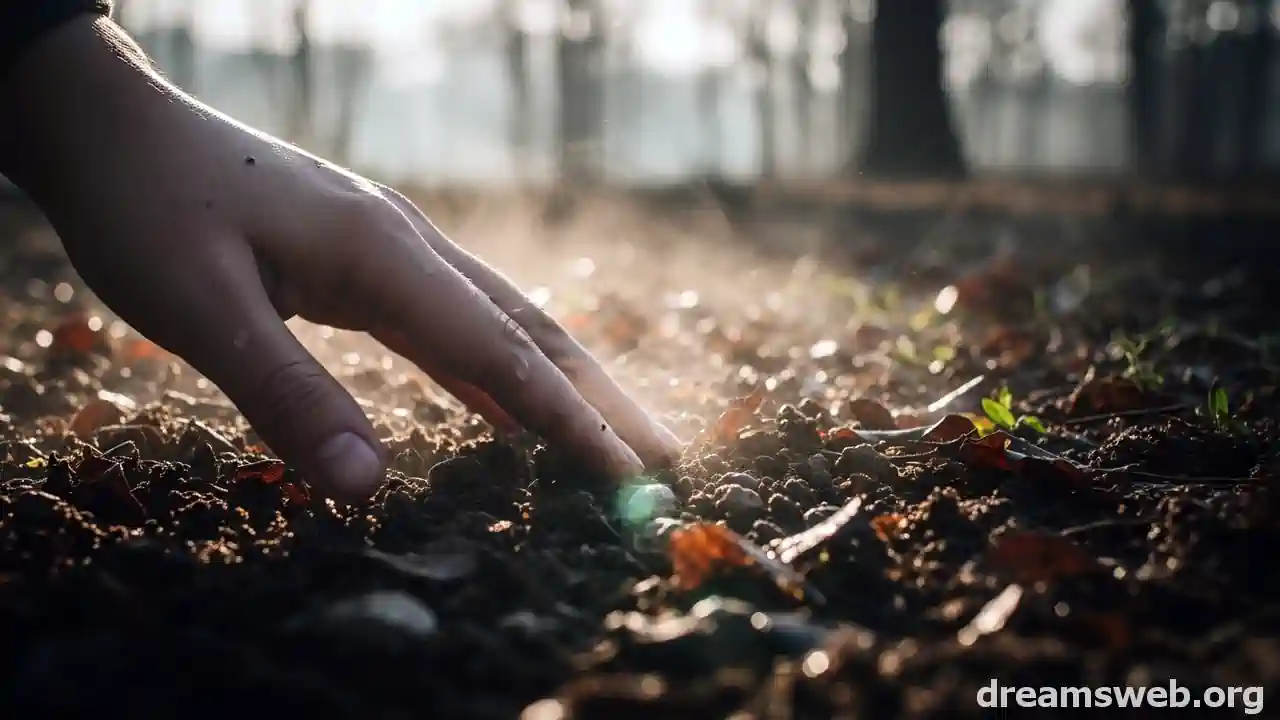
There are dreams that vanish the moment you open your eyes. And then there are dreams that stay — not in vivid color or dramatic action, but in sensation. The cool weight of damp soil beneath your palms. The smell of wet earth after rain. The strange stillness of standing in a garden that somehow feels like it belongs to you.
If you have ever woken from such a dream carrying that heavy, grounded feeling, you are not alone. Damp soil dreams are more common than most people realize — and they tend to appear during some of the most quietly difficult chapters of a person’s life.
This is not a coincidence. The subconscious mind is fluent in metaphor. And few symbols in the dream landscape carry as much meaning as the earth beneath your feet.
—What Does Damp Soil in a Dream Actually Mean?
At its most elemental level, damp soil in dreams represents the intersection of two primal forces: earth and water. Earth is stability, rootedness, the physical body. Water is emotion, flux, the unconscious stream. When the two merge in your dreamscape, your inner world is trying to show you something it cannot say in waking language.
Dream therapists and somatic psychologists often refer to this phenomenon as somatic dreaming — the process by which the body encodes its physical condition into dream imagery. When your muscles are tense with unspent stress, when your adrenal glands are running on fumes, when your nervous system has forgotten what quiet feels like — the dreaming mind reaches for symbols that mirror that interior state.
Damp soil is one of those symbols. It is saturated. It yields under pressure. It holds more than it was perhaps meant to hold. Sound familiar?
Jungian analysts have long associated earth imagery with the chthonic layer of the psyche — the deep, instinctual, pre-rational dimension of the self that operates beneath conscious thought. When damp soil appears in dreams, it often signals that this deeper layer is calling for attention. Not urgently. Not with alarm. But with the quiet, persistent insistence of something that has been patient for a long time.
—Why Your Mind Turns Exhaustion Into Earth and Mud
The brain does not produce random imagery during sleep. Every symbol in a dream is drawn from a reservoir of personal association, collective memory, and physiological sensation. So when exhaustion — chronic, creeping, bone-deep exhaustion — reaches a certain threshold, the mind begins to dream in earth.
Think about what damp soil actually is: ground that has absorbed more than its usual share. It is heavier. It clings. It does not drain easily. These are not metaphors that require much decoding — they are almost uncomfortably literal translations of what an overextended body feels like from the inside.
Research in sleep science has shown that the sleeping brain frequently recruits physical sensations as dream material. Muscle tension becomes a dream of being unable to run. Shallow breathing becomes a dream of being underwater. And pervasive, low-grade fatigue — the kind that accumulates quietly over weeks or months — often becomes earthy, waterlogged landscapes.
A dream therapist might describe this as the psyche’s compensatory function at work. The dreaming mind does not simply replay your day. It compensates for what is missing in waking life. If your waking hours are relentless and untethered, your dreams will reach for stillness, groundedness, and the elemental slow pace of the natural world.
Damp soil is that slow pace made visible.
—The Hidden Link Between Wet Soil Dreams and Burnout
Burnout is not a sudden event. It is a gradual accumulation — a slow waterlogging of the self, if you will. Day after day, responsibility after responsibility, the soil of your inner life absorbs what it cannot release. Until one night, the dream arrives: dark earth, heavy with moisture, yielding under your hands or feet.
Wet soil dreams are particularly prevalent among people who are in what psychologists call the depletion phase of chronic stress. This is the stage that follows prolonged activation — when the body and mind have moved past the urgency of a crisis and settled into a numb, heavy, difficult-to-name fatigue.
Interestingly, people in this phase often do not identify as burned out. They describe themselves as “just tired” or “not quite themselves.” They are functional but dimmed. The damp soil dream, then, serves as a kind of interior diagnostic — an honest report from below the surface that the conscious mind may be too busy or too proud to acknowledge.
Carl Jung wrote about the compensatory nature of dreams with particular insight: the unconscious, he argued, always knows what the conscious mind does not want to see. When your waking self insists it is fine, your dreaming self will show you wet, heavy earth.
—Common Feelings Damp Soil Dreams Leave Behind
One of the most useful ways to interpret any dream is not to analyze the image itself, but to examine the emotional residue it leaves in your waking body. Dreams of damp soil tend to produce a distinctive emotional signature — one that is worth sitting with rather than brushing aside.
A Feeling of Heaviness
Many people wake from these dreams carrying a specific physical weight — a sense of density in the chest or limbs that lingers into the first hours of morning. This is not dysphoria. It is more like gravity. The dream has briefly connected you to the full weight of your own depletion, and your body is still holding that honest acknowledgment.
A Strange Sense of Peace
Paradoxically, some dreamers report feeling oddly comforted by damp soil dreams. There is something about the smell of wet earth, the coolness of it, the solidity beneath the softness, that the nervous system recognizes as safe. This is not wishful thinking — the neurological relationship between humans and soil-related sensory stimuli is well-documented. Some researchers have connected the scent of geosmin (the compound that produces that distinctive post-rain smell) to measurable reductions in cortisol. Even in dream form, the symbolism of damp earth may carry a vestigial calming effect.
Shame and Self-Judgment
Not all emotional residue is gentle. For high-achieving individuals or those conditioned to equate productivity with worth, waking from a dream of sitting in wet mud can produce a flash of shame. The dream has exposed vulnerability — an admission that the soil of the self is oversaturated. That feeling of shame is worth noticing. It often reveals the precise internal narrative that is contributing to the exhaustion in the first place.
A Sense of Freedom
In some versions of these dreams, the damp soil is not suffocating but liberating. You are barefoot. You are pressing your hands into the earth deliberately. There is a quality of release — something being given back to the ground. These dreams often arise at turning points: when a person has decided, consciously or not, to put something down. To stop carrying it. The earth receives what you can no longer hold.
Fear
When the soil feels like it is pulling you down — when the earth beneath you seems unstable, sinking, or swallowing — fear is the natural response. This version of the dream often points to a loss of footing in waking life. A relationship, a career, a sense of identity that no longer feels solid beneath you. The damp earth here is not just tired — it is uncertain.
—When Muddy Ground in Dreams Signals Emotional Overload
There is a meaningful distinction between damp soil and mud in the dream lexicon. Damp soil retains its structure. It is heavy but coherent. Mud, by contrast, has lost that structure. It flows where it should stand firm. It is difficult to navigate. It clings to everything it touches.
When your dreamscape shifts from garden earth to actual mud — particularly if you are struggling to walk through it, or sinking into it, or watching it spread uncontrollably — this is often the subconscious communicating emotional overload rather than simple physical fatigue.
Dream researchers who work within a psychodynamic framework describe mud as a symbol of unmetabolized emotion: feeling states that have not been processed, named, or given adequate expression. Grief that was bypassed. Anger that was suppressed. Worry that was reframed as productivity. Over time, these accumulate in the inner landscape like sediment — and eventually, they make the ground difficult to walk on.
If your damp soil dream involves mud that traps or overwhelms you, it may be worth asking: what emotion am I not letting myself fully feel right now?
—Damp Soil Symbolism Across Different Dream Scenarios
The meaning of damp soil shifts depending on the broader context of the dream. Here are some of the most common scenarios and what they tend to reflect:
Digging in Wet Soil
Digging is an act of excavation — of going beneath the surface to find something buried. If you are digging in damp, yielding earth, your psyche may be urging you to investigate what lies beneath your current emotional state. What are you searching for? What have you buried that needs to be brought into light?
Walking on Damp Soil
This is often the gentlest version of the dream — a slow walk across moist ground, usually in a garden, field, or forest. The dominant sensation is usually one of deliberate slowness. The earth pushes back gently with each step. This dream frequently appears when a person is in a period of recovery or deceleration — the body’s way of rehearsing a slower pace in preparation for actually adopting it.
Planting Seeds in Wet Earth
A dream of pressing seeds into damp, receptive soil carries a notably different energy — it is forward-looking. Despite the exhaustion implied by the saturated earth, this scenario suggests the dreamer still holds faith in future growth. Something is being initiated, even if it must be done slowly and with great care.
Lying in or on Damp Soil
This is perhaps the most intimate version of the dream, and one of the most psychologically significant. To lie on the earth — to surrender the upright posture of waking life and allow the body to be fully supported from below — is a profound act of somatic trust. In dream form, it often signals an urgent need for genuine rest, not just sleep, but the kind of deep, restorative stillness that modern life rarely permits.
Watching Soil Become Waterlogged
To observe damp soil becoming increasingly saturated — water pooling where it cannot be absorbed — reflects a sense of overwhelm that has passed the point of management. This is a dream worth taking seriously. It often arrives when a person’s coping strategies have been exhausted and the situation genuinely requires intervention, whether that means asking for help, making a significant life change, or consulting a professional.
—How Stress Reshapes the Way You Dream About Nature
Under ordinary circumstances, nature imagery in dreams tends to be relatively benign: green fields, gentle rain, familiar trees. But under sustained stress, something shifts. The landscapes become heavier, more laborious, more saturated. The sunshine becomes overcast. The paths become difficult. The soil becomes damp and resistant.
This shift is not arbitrary. The autonomic nervous system — which governs the body’s stress response — directly influences the emotional tone of dreaming. A nervous system running in chronic sympathetic activation (the state of low-grade alertness that accompanies prolonged stress) produces dreams with a noticeably different quality than one operating in its parasympathetic, restful mode.
Studies in psychophysiology have found that people with elevated baseline cortisol tend to report more effortful, heavy, and environmentally challenging dream landscapes. The ground is harder to move through. The air is thicker. The familiar becomes strange and resistant. Damp soil dreams fall squarely within this pattern.
Recognizing this connection is not about pathologizing your dream life. It is about learning to read it with the same attentiveness you might bring to a letter from a trusted friend. The dream is not alarming you — it is informing you.
—Recurring Wet Earth Dreams and What Your Body Needs
A single damp soil dream is worth noticing. A recurring one is worth heeding.
Recurrence in dream symbolism is almost always a sign of an unmet need — something the psyche has attempted to communicate and, receiving no adequate response, sends again. If you find yourself returning to wet, heavy earth night after night, your inner world is not being dramatic. It is being persistent.
What does it need from you? In most cases, the answer is simpler than we expect — and more difficult than we want:
Physical rest. Not the compromise of scrolling in bed until sleep takes you. Not the truncated six hours between late nights and early alarms. The body may be asking for an actual change in your relationship with rest — longer nights, unhurried mornings, deliberate pauses during the day.
Emotional processing. The wet earth often holds something. If recurring dreams of damp soil leave you with a specific emotional residue — sadness, anxiety, a nameless heaviness — that feeling may be pointing toward something that has not yet been given adequate space in your waking life.
Contact with the actual earth. This may sound overly literal, but it is worth considering. Barefoot walks on grass. Time in a garden. Sitting outside with your hands in the dirt. The somatic experience of actual grounded contact with the natural world has measurable effects on the nervous system — and it may be precisely what the recurring dream is symbolically requesting.
A slower pace. Damp soil does not move quickly. Nothing grows quickly in it. The dream may simply be inviting you to match that tempo — to let things be slow for a while, without guilt or urgency.
—The Spiritual Meaning of Damp Soil in Dreams
Across traditions and centuries, earth has been understood as more than a physical substance. It is the medium of life — the substance from which living things emerge and to which they return. In many spiritual frameworks, soil represents the sacred ground of being: the place where the material and the divine make contact.
In this context, wet soil dreams carry a spiritual invitation. They ask: are you grounded in what actually matters? Are you rooted in something that sustains you, or are you reaching upward from soil that has grown too heavy and waterlogged to nourish?
Many contemplative traditions speak of the value of returning to what is essential — stripping away the accumulated noise of obligation, performance, and productivity to find the quiet center beneath. The damp earth of the dream may be calling you to exactly that kind of return. Not a dramatic upheaval, but a gentle re-rooting.
Some indigenous cosmologies understand the earth itself as a living, conscious entity that dreams alongside the humans who walk upon it. In this view, a dream of damp soil is not merely personal — it is relational. The earth reaches into sleep to remind us of our kinship with the slow, patient rhythms of the living world.
Whatever your spiritual orientation, the invitation at the heart of this dream is consistent: come back to earth. Come back to your body. Come back to what is real and nourishing and slow enough to actually sustain you.
—Simple Steps to Take After a Damp Soil Dream
Dream interpretation is only useful when it connects to action — not grand gestures, but small, honest movements in the direction the dream is pointing.
If you wake from a damp soil dream, consider these modest, grounded responses:
Write it down. Before the dream fades, note the most prominent sensation — not just the image, but what it felt like in your body. That feeling is the message.
Ask yourself one honest question. “Where in my life am I carrying more than my usual capacity?” Sit with the answer without rushing to fix it.
Do one restorative thing today. Not a productivity hack. Not a self-improvement project. Something genuinely restorative: a nap, a slow meal, a walk outside, an hour without obligation.
If the dreams recur, consider speaking with someone. A therapist, a dream analyst, a trusted friend who knows how to listen. Recurring dreams often carry messages that benefit from being spoken aloud.
You do not need to overhaul your life in response to a dream of wet earth. You simply need to hear it. To acknowledge, quietly and without judgment, that the soil is full — and that it might be time to let some things drain away before you ask it to hold any more.
—The dreaming mind is not dramatic. It does not send neon signs or megaphone announcements. It sends damp soil. It sends the smell of rain on dark earth and the specific gravity of something saturated beyond its comfortable capacity. It sends, quietly and persistently, the image of a body of land that needs to rest before it can grow again.
Perhaps, this morning, that is exactly what you need to hear.
Frequently Asked Questions
Common questions about damp soil dreams, their meanings, and what your subconscious may be telling you.
What does damp soil in a dream mean?
Dreaming of damp soil often reflects deep physical or emotional exhaustion. It is a subconscious signal that your inner world needs grounding, stillness, and recovery.
Is dreaming of wet soil a bad sign?
Not necessarily. Wet soil dreams can signal burnout or emotional overload, but they also point toward renewal and the body’s natural call for rest.
What does wet earth symbolize spiritually?
Spiritually, damp earth represents a return to what is essential. It invites you to slow down and reconnect with what truly sustains your inner life.
Why do I keep dreaming about soil and earth?
Recurring soil dreams often signal an unmet need for rest or emotional processing. The subconscious repeats the image until the waking mind genuinely responds.
What feelings does a damp soil dream leave behind?
These dreams often leave a feeling of heaviness, quiet peace, or unexpected shame. The emotional residue is usually more meaningful than the image itself.
What should I do after a damp soil dream?
Note how the dream felt in your body. Then do one genuinely restorative thing — rest properly, walk outside, or allow yourself to simply slow down today.


Leave a Reply