


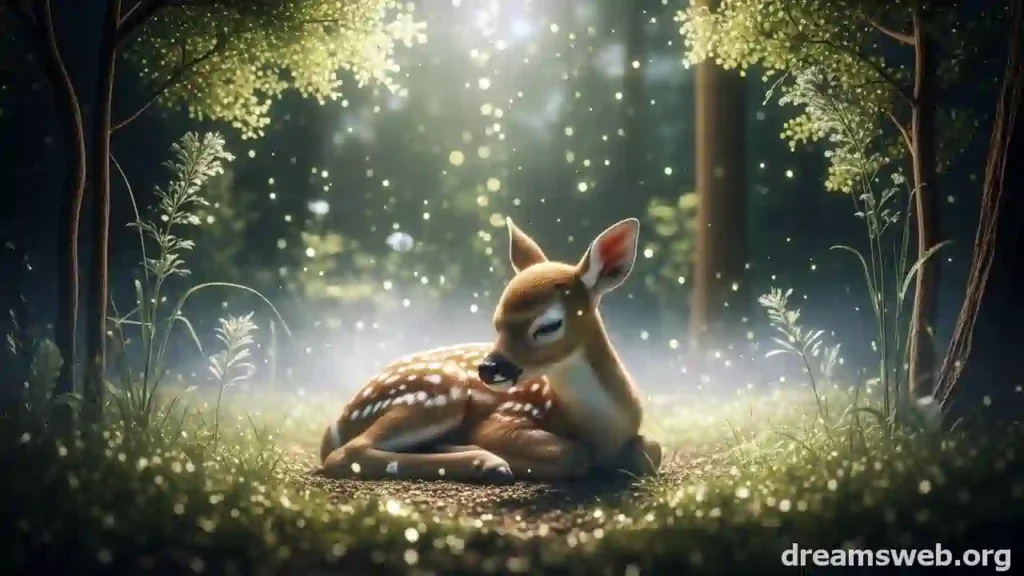
Dreams have a quiet language of their own. They do not shout meanings at you — they whisper them through images, feelings, and symbols that linger long after you open your eyes. One of the most tender and thought-provoking of these symbols is the baby deer, or fawn. Small, wide-eyed, and impossibly gentle, a fawn appearing in your dream is rarely something you forget quickly. There is something about it that stays with you — a soft emotional residue that asks to be understood.
If you have recently dreamed of a baby deer and found yourself searching for what it means, you are already doing something important: paying attention. This article will walk you through the layered meanings behind this dream symbol, from its emotional roots to its cultural history, and offer you a thoughtful framework for making sense of what your sleeping mind may be trying to tell you.
What Does a Baby Deer Actually Symbolize in Dreams?
Before diving into interpretations, it helps to understand what a baby deer represents on a basic, instinctive level. When most people see a fawn — even just a photograph — they feel something immediately: softness, vulnerability, innocence. These are not random emotional responses. They are deeply wired into how humans perceive young, fragile creatures. Dream researchers and Jungian analysts often refer to this as the numinous quality of certain symbols — a quality that evokes feeling before thought.
In dreams, a baby deer typically carries several interlocking themes:
- Innocence and purity — the fawn has not yet been shaped by the world’s harshness
- Vulnerability and sensitivity — something precious that needs care and protection
- New beginnings — fawns are born in spring, nature’s universal symbol of renewal
- Gentleness — both as a quality you possess and one you may be seeking
- Instinct and awareness — deer are extraordinarily alert creatures, always attuned to their surroundings
A baby deer in a dream does not carry a single fixed meaning. Like most dream symbols, its message depends heavily on context — what happened in the dream, how you felt, and what is currently unfolding in your waking life.
The Spiritual Meaning Behind Seeing a Fawn While Sleeping
Across spiritual traditions, deer have long been regarded as liminal creatures — beings that exist between the ordinary and the sacred. They appear at the edges of forests, at the threshold between the wild and the domestic. In many traditions, seeing a deer — especially a young one — is considered a message from a deeper realm of consciousness or from nature itself.
In Native American spiritual frameworks, the deer is frequently associated with gentleness, heart-wisdom, and the ability to navigate challenges without aggression. Some traditions specifically view the fawn as a symbol of unconditional love — the kind that does not demand strength or perfection, only tenderness. A baby deer in a dream, within this context, may be pointing you toward a need to approach something in your life — or someone — with more grace and less force.
In Celtic traditions, deer were considered guides between worlds. They were associated with the otherworld and with messages that transcended ordinary logic. Dreaming of a fawn in this lineage might be interpreted as a nudge toward trusting your intuition over rational analysis.
In Eastern philosophical traditions, particularly those influenced by Taoism, the deer symbolizes longevity, peacefulness, and harmony with the natural order. A baby deer would amplify that symbolism with the added dimension of beginnings — suggesting that the dreamer is at the very start of something spiritually significant.
Whether or not you hold any of these beliefs personally, they are worth knowing. They reveal how consistently humans across vastly different cultures have associated deer — and particularly fawns — with gentleness, transition, and sacred attention.
Is Your Dream Fawn a Warning or a Welcome Change?
This is often the first question people ask, and it is a fair one. Dream symbols can function in two broad ways: as reflections of something already present in your inner world, or as nudges toward something you have not yet considered.
A baby deer in a dream tends to lean toward the latter. It is rarely a symbol of threat or danger. However, the condition of the fawn and the emotional tone of the dream can shift the interpretation considerably.
Consider the following scenarios:
If the fawn was healthy, calm, and nearby: This is generally an affirming sign. It may indicate that something new and tender is taking root in your life — a relationship, a creative project, a shift in perspective — and that it deserves your gentle attention. The dream may be encouraging you not to rush what is still forming.
If the fawn was injured or in distress: This carries a different weight. It may reflect your own sense of vulnerability — a part of yourself that feels exposed, unprotected, or not yet strong enough to face what it is encountering. It can also point to concern for someone in your life who seems fragile or at risk.
If the fawn was alone and lost: Solitude and disorientation in a young animal often mirror feelings of being untethered — without guidance or belonging. This dream configuration may arise during periods of significant life transition, when your former anchors have shifted and new ones have not yet formed.
If you were protecting or nurturing the fawn: This is one of the more powerful variations. It suggests an awakened caregiving instinct — either toward another person, toward a new beginning in your own life, or toward a tender, emerging version of yourself.
In most cases, a baby deer in a dream is not a warning in the alarming sense. It is more often a gentle alert — drawing your awareness to something delicate that exists in your life and deserves more conscious tending.
Baby Deer Dreams Across Cultures and Ancient Belief Systems
It is striking how universally the deer appears in human mythology. From the forests of northern Europe to the plains of Asia, from indigenous American cosmologies to the artistic iconography of ancient Mesopotamia, the deer has been a persistent presence in the human imagination. Understanding this cross-cultural consistency adds depth to how we interpret fawn symbolism in dreams.
In ancient Greek mythology, the golden-horned deer was sacred to Artemis, goddess of the hunt, the moon, and the wild. Artemis was also a protector of children and young creatures. The deer’s association with her suggests a dual nature: the fawn is both something that can be hunted (vulnerable) and something divinely protected. This tension between fragility and guardedness is often exactly what appears in dreams.
In Japanese culture, deer are considered sacred messengers of the gods, particularly at the famous Nara Deer Park, where they have roamed freely for over a thousand years. They are regarded as shika — literally divine animals. Seeing a fawn in a dream within this cultural lens might be understood as receiving a gentle divine message, perhaps about humility or sacred attention.
In Hinduism, the deer is associated with the mind — specifically with its tendency to dart quickly from thought to thought, alert and reactive. Some interpretations suggest that dreaming of a fawn represents a mind that is awakening — becoming more aware, more sensitive, more attuned to its surroundings.
What all of these traditions share is a view of the deer — and especially the fawn — as something inherently connected to grace, to attention, and to a kind of knowing that exists below the surface of ordinary perception. This is not coincidental. It reflects something real about how these animals move through the world, and how we instinctively respond to them.
How Your Emotions in the Dream Shape Its True Meaning
One of the most important yet overlooked aspects of dream interpretation is emotional memory — not what happened in the dream, but how you felt during and after it. Two people can dream of the same image and carry away entirely different messages, because the emotional context was different.
When you dreamed of a baby deer, what was the dominant feeling?
Wonder and awe: If you felt moved or quietly amazed, the dream is likely pointing toward something in your life that deserves reverence. You may be on the edge of a realization or experience that has the potential to genuinely change you, and your deeper mind is preparing you to receive it with openness.
Tenderness or protectiveness: These feelings suggest that your nurturing instincts are activated. This might relate to a person, a project, a relationship in its early stages, or even your own healing process. The fawn, in this case, may represent something you are quietly caring for — perhaps without even fully realizing it.
Sadness or longing: A melancholy fawn dream often emerges during times of loss or transition. The baby deer may represent innocence you feel has been lost, or a simpler time you miss. It can also signal grief — not necessarily for a person, but for a phase of life, a version of yourself, or a possibility that did not unfold as you hoped.
Fear or anxiety: If you felt afraid for the fawn, or afraid of something in the dream environment, this points to protective anxiety — a fear that something precious and still-developing in your life might be threatened. It is worth asking: what in your current circumstances feels vulnerable and in need of safeguarding?
Emotions in dreams are not decorative. They are the actual content. The image of the fawn is the container; the feeling is the message.
Common Baby Deer Dream Scenarios and What They Reveal
Because dreams rarely present symbols in isolation, let us look at some of the most frequently reported baby deer dream configurations and what they tend to communicate.
A fawn following you: This is often interpreted as a sign of trust — something new or vulnerable in your life is gravitating toward you, sensing safety in your presence. It may also reflect a part of yourself that is seeking your own attention and care.
Feeding a baby deer: Dreams in which you are nourishing an animal typically reflect a strong creative or caregiving energy. You may be in a phase of life where you are investing deeply in something — a person, a goal, a new skill — and the act of feeding represents that sustaining attention.
A fawn in a forest clearing: Open, natural spaces in dreams tend to represent freedom and possibility. A baby deer in a clearing may suggest that something new is emerging into the light — a feeling, a truth, a new direction — after having existed quietly in the shadows.
A fawn that runs away: This can feel unsettling, but it is not necessarily negative. A deer that retreats may represent something that cannot be forced — an emotion, a relationship, a creative idea — that requires patience and stillness rather than pursuit.
Holding a fawn: Physical closeness in a dream carries intimacy and responsibility. Holding a baby deer suggests a profound sense of guardianship — you are holding something precious and temporary, aware of its fragility. This dream often appears during pivotal life moments: new parenthood, new love, the beginning of a major life chapter.
A fawn near water: Water in dreams is widely associated with emotion and the unconscious. A fawn near water amplifies the theme of emotional sensitivity — suggesting that you are in touch with both your tenderness and your depth.
When a Fawn Dream Signals a Fresh Chapter in Your Life
Sometimes a baby deer in a dream is less about a specific meaning and more about a broader energetic signature — a signal that something genuinely new is beginning.
This type of dream tends to appear at particular inflection points: after a period of prolonged difficulty, just before a significant decision, or during a quiet stretch where change feels imminent but not yet visible. The fawn, as a creature that represents the earliest stage of life, naturally corresponds to the earliest stage of transformation.
If you have recently been through something that tested you — a loss, an ending, a period of uncertainty — and you dream of a baby deer, it may be your inner world’s way of telling you that something new is quietly arriving. Not loudly, not dramatically, but with the same unhurried grace that a fawn enters a meadow at dawn.
New beginnings in real life rarely announce themselves with fanfare. They tend to arrive gently, almost tentatively, much like the symbol itself. The dream may be asking you to notice this — to slow down enough to recognize what is emerging before it has fully taken shape.
This is perhaps the most hopeful reading of a fawn dream, and one that resonates deeply for many people who encounter it after turbulent seasons. The baby deer becomes a quiet harbinger — not of dramatic change, but of tender, organic renewal.
Baby Deer in Dreams During Grief, Change, or Uncertainty
It is not uncommon for this particular dream to surface during times of emotional upheaval. When the familiar structures of life loosen — through loss, major transition, illness, or existential questioning — the unconscious mind often reaches for symbols that speak to vulnerability and new growth simultaneously.
A baby deer in a dream during a grief period may represent the dreamer’s own wounded softness. The fawn is not dead — it is young, alive, but fragile. This distinction matters. It suggests that even amid loss or pain, something in you is still alive, still capable of growth, still deserving of care.
During periods of major change — a career shift, a relocation, the end of a relationship — the fawn may appear as a stand-in for your own sense of being newly placed in an unfamiliar landscape. Like a fawn separated from its familiar terrain, you may be navigating territory you do not yet fully know. The dream, in this case, is not predicting danger. It is naming a feeling — and in naming it, offering a kind of companionship.
During uncertainty, fawn dreams often carry a quieting quality. People who experience them frequently report waking with a sense of calm they cannot fully explain — as though the dream itself delivered a form of reassurance that words cannot quite replicate. This is the affective residue of a symbol well-received: not a logical conclusion, but an emotional landing.
How to Reflect on Your Fawn Dream and Apply Its Message
Understanding a dream intellectually is only part of the work. The more meaningful task is integrating what it offers into your actual, waking life. Here are some gentle, practical ways to do that.
Write it down before analyzing it. Before you search for meaning, write the dream exactly as you remember it — images, feelings, sequence, atmosphere. The act of recording anchors the experience and often reveals details that memory alone would lose.
Sit with the feeling first. Ask yourself: what was the dominant emotional tone of the dream? Let that feeling be your primary clue. The imagery is the vehicle; the emotion is the destination.
Ask what the fawn reminds you of in your waking life. Is there something in your life right now that feels new, fragile, or needing protection? A baby deer in a dream almost always has a real-world correlate — something your deeper awareness has identified as tender and significant.
Notice what you did in the dream. Were you passive, active, protective, afraid? Your behavior toward the fawn often mirrors the attitude you are currently taking — or need to take — toward whatever it represents in your life.
Give it time. Not every dream reveals its full meaning immediately. Some dreams unfold like slow-release messages — their significance becoming clearer over days or weeks as waking-life circumstances develop. Return to the dream periodically and see whether its meaning has sharpened.
A baby deer in a dream is, at its core, an invitation to pay attention — to the soft things, the new things, the things that are just beginning to find their footing. In a world that rewards speed and certainty, this kind of dream asks something more unusual of you: patience, gentleness, and the willingness to be present with what is still becoming.
That is not a small ask. But it may be exactly the right one.