
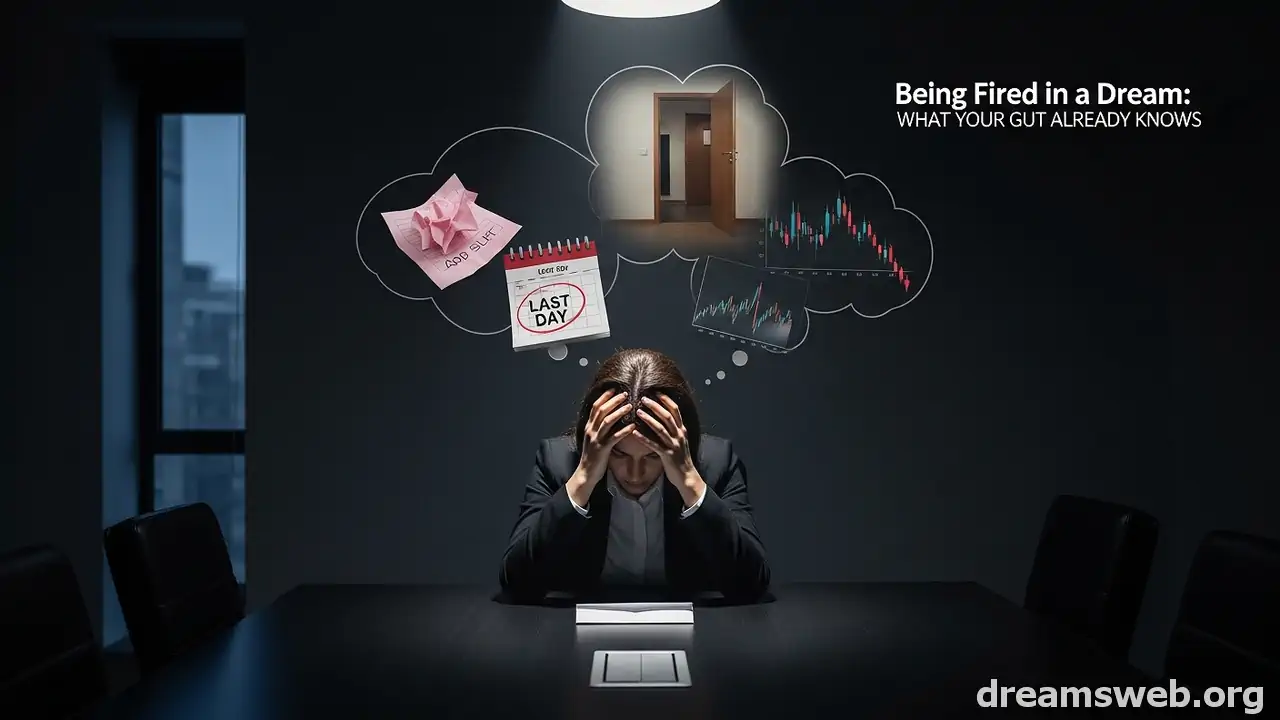
Being fired in a dream typically reflects suppressed anxiety about self-worth, job security, or your sense of professional identity — not a literal prediction. The dreaming mind uses dismissal imagery to surface emotions about control, approval, or belonging that waking life hasn’t fully processed. The feeling you carry out of the dream is your most reliable guide.
You wake up with your heart slightly off-rhythm. For a moment, the dream still feels real — your manager’s voice, the uncomfortable silence of a conference room, the hollow sensation of having something important taken away. And then reality reassembles itself, and you realize you still have your job. But the feeling lingers. It follows you into the shower, into your morning coffee.
If being fired in a dream has visited your sleep, you are far from alone. This is one of the most commonly reported occupational dream scenarios across age groups and cultures. And yet, despite how widespread it is, the experience leaves most people with the same quiet question: What was that actually about?
This article walks through what your sleeping mind was really processing, why the unconscious reaches for this particular scenario, and what the specific details of your dream — who fired you, where you were, how you felt — reveal about what is already moving beneath the surface of your waking life.
Why Your Brain Stages a Firing Scene While You Sleep
The dreaming brain is not a random noise generator. It is a pattern-recognition system working overtime on whatever your conscious mind didn’t fully metabolize during the day. Emotionally charged experiences — a tense interaction with a supervisor, an unacknowledged fear about performance reviews, a quiet doubt about whether you belong in your current role — these don’t disappear when the workday ends. They migrate inward.
During REM sleep, the hippocampus and amygdala are especially active. The amygdala, which handles threat detection and emotional memory, tends to reach for high-stakes scenarios when constructing its overnight narratives. Few scenarios carry as much psychological charge in the modern world as professional dismissal. Losing a job is not just a financial event — it is an identity event. For many people, what they do and who they are have become closely intertwined. A dream that threatens your position is, in this sense, a dream that threatens something much more fundamental.
This is why being fired in a dream tends to feel so viscerally real. Your brain is not just narrating a story. It is running a full emotional simulation of something it perceives as a genuine threat to the self.
What Being Fired in a Dream Usually Points To
At its interpretive core, a fired from job dream is rarely about the job itself. Dream researchers and depth psychologists consistently find that occupational anxiety dreams function as displacement narratives — the mind borrows familiar, emotionally recognizable imagery from the professional realm to process feelings that actually originate in more personal territory.
The most common underlying themes behind this dream include:
Fear of inadequacy. A pervasive, often unspoken concern that your abilities, your contributions, or your value will eventually be exposed as insufficient. This is sometimes called impostorism in psychological literature — the gnawing sense that others will eventually discover a gap between how you are perceived and how capable you believe yourself to truly be.
Desire for change. Counterintuitively, some dismissal dreams arise not from fear of losing your current role, but from a suppressed wish to leave it. The unconscious sometimes stages the very scenario it is afraid to consciously request. If some part of you wants an exit from your current professional situation, your dreaming mind may manufacture the exit for you — in the only place it safely can.
Unprocessed conflict. A difficult conversation that didn’t happen, feedback that stung and was never acknowledged, a relationship with a manager or colleague that feels precarious — these unresolved relational tensions frequently find their way into dismissal dreams. The mind is working through the emotional residue of what was left unsaid.
Identity uncertainty. Periods of career transition, promotion, demotion, or significant role change often generate job loss dreams as a natural byproduct. When your professional identity is in flux, the dreaming mind explores its edges — testing what it would feel like to lose the role entirely, as a way of understanding how much of yourself lives inside it.
The Emotions You Feel Mid-Dream Actually Matter Most
Here is a principle that applies across almost every category of dream interpretation, and it is especially true for being fired in a dream: the imagery is the vehicle. The emotion is the destination.
Two people can dream about being dismissed from a job and wake up with entirely different messages waiting for them — because they felt entirely different things in the experience. A brief emotional inventory of your fired dream is more useful than any symbol dictionary:
Relief or liberation. If dismissal in the dream brought an unexpected sense of lightness, the interpretation is almost always about readiness for change. Some part of you is already prepared — perhaps eager — to move on from your current role, environment, or career path. The dream is not warning you. It may be granting you permission you haven’t yet given yourself.
Humiliation or shame. This version tends to surface when the dreamer carries a strong personal investment in being seen as competent. The shame-fired dream reflects a fear of social judgment — of being publicly diminished, of failing to meet a standard you have imposed on yourself, or that you believe others have imposed on you.
Confusion or disorientation. A dismissal that arrives without explanation in the dream — no reason given, no warning signs — often mirrors a waking state of uncertainty. Something in your professional or personal landscape currently feels arbitrary, unpredictable, or beyond your control.
Anger. When the fired dream generates indignation rather than shame, the psychological read often points to boundary violations. Something in your current work situation feels unjust, unrecognized, or deeply misaligned with your values. The anger is the message.
Numbness or detachment. Perhaps the most psychologically interesting version. If you watched the firing happen as though observing from a distance, your mind may be processing a degree of dissociation from your current role — a quiet withdrawal of emotional investment that is already underway, even if you haven’t consciously registered it yet.
Recurring Job Loss Dreams and What They Signal Over Time
A single dismissal dream is usually no more than a one-night processing event — your mind running a stress simulation it needed to complete. But when the same scenario begins to repeat across multiple nights, or resurfaces at predictable intervals, the interpretive gravity increases considerably.
Recurring dreams of any kind are the unconscious mind’s persistence mechanism. They are the psyche’s equivalent of a flagged notification that was dismissed without being read. The scenario returns because the underlying emotional condition it is attempting to process remains unresolved in waking life.
For recurring job loss dreams, the pattern often corresponds to one of three things: a chronic, low-grade workplace anxiety that has become normalized and therefore unaddressed; a long-deferred career decision that continues to produce internal pressure; or a deeper identity conflict about the role work plays in your sense of self-worth.
There is a useful parallel here with the experience of dreaming of a locked door you cannot open — another obstruction dream that recurs precisely because the underlying emotional blockage in waking life has not yet been cleared. Both dream types use frustration and foreclosure as their central imagery, and both tend to persist until whatever they are pointing toward receives conscious attention.
If you are experiencing recurring dismissal dreams, the most productive response is not to analyze the dream more deeply — it is to look more honestly at the waking circumstance it keeps returning to illuminate.
Does This Dream Predict Anything About Your Real Career
The short answer is no — and this point deserves to be stated plainly, because the anxiety that follows a vivid fired from job dream can sometimes generate a secondary concern: is this some kind of warning?
Dreams are not oracular. They do not receive advance information from the external world. What they do have access to is your internal world — your pattern-recognitions, your accumulated emotional data, your subconscious readings of situations your conscious mind may have overlooked or minimized.
In this limited sense, a dismissal dream can occasionally reflect something your gut has already clocked before your rational mind caught up. If you have been absorbing subtle signals at work — a shift in how your manager communicates, a restructuring announcement, an unusual coolness in previously warm professional relationships — your dreaming mind may have registered and narrativized those signals before you consciously processed them.
But this is not prophecy. It is pattern recognition. The dream is surfacing what you already know at some level, not transmitting news from the future. The appropriate response to this kind of dream is not superstitious anxiety — it is thoughtful self-inquiry. What have I already noticed that I haven’t yet allowed myself to think about directly?
Hidden Stress Triggers That Feed This Type of Dream
Not all stress is loud. Some of the most potent triggers for occupational anxiety dreams operate at a level well below conscious awareness — which is precisely why the dreaming mind, with its more direct access to emotional memory, surfaces them instead.
Performance reviews are a particularly reliable generator of being fired in a dream scenarios, even when the dreamer feels objectively confident about the outcome. The formal evaluation structure itself — being assessed, judged, found sufficient or insufficient — activates deep-seated emotional pathways around worthiness and approval that have little to do with actual job performance.
Periods of organizational uncertainty — mergers, layoffs elsewhere in the company, leadership changes — also produce significant spikes in dismissal dreams, even among employees who feel personally secure. The mere environmental presence of threat is enough to activate the dreaming mind’s threat-simulation machinery.
Perhaps less obviously: creative stagnation, professional boredom, and a sense of being underutilized can also generate dismissal dreams. The dreaming mind, in these cases, may be processing not the fear of losing the job, but the grief of already having lost something essential about the work — the meaning, the engagement, the sense of contribution.
How Your Waking Life Shapes the Story Your Dreams Tell
Dreams do not arrive from nowhere. They are assembled from the materials of your waking experience — relationships, fears, ambitions, unresolved conversations, half-formed concerns. Understanding this assembly process is central to reading any dream with real accuracy.
For dismissal dreams specifically, the narrative details that appear — the location, the tone, the specific individuals present — are not arbitrary set dressing. They are data. The office where the firing takes place in your dream is not necessarily your actual office. It may be a composite of several workplaces, or the physical space may represent a relational dynamic rather than a literal location. The manager who fires you may be drawn from a real person, but may also be the psyche’s personification of an internal critic.
Dream researchers who work within the cognitive tradition describe this as the continuity hypothesis of dreaming: the content of dreams reflects the concerns, preoccupations, and emotional textures of waking life. This is not a mystical claim — it is simply a description of how the dreaming mind sources its material. Your most recent waking anxieties are also your most likely dream subjects.
This is also why the same person’s dismissal dream can carry entirely different meanings at different points in their life. A 24-year-old in their first professional role dreaming about being fired is likely processing something quite different from a 45-year-old mid-career professional having the same dream after two decades in their field. Context is not incidental to dream interpretation. It is the interpretation.
Dream Variations: Who Fires You and Why the Details Differ
The identity of the person delivering the dismissal in your dream is one of the most symbolically loaded details to examine. It is also one of the most consistently overlooked.
When a Boss or Authority Figure Does the Firing
This is the most common variation, and it tends to reflect the dreamer’s relationship with authority more broadly. The boss figure in a dismissal dream is not always a literal representation of your actual manager — it is often the psyche’s symbol for any source of external evaluation or approval. Being dismissed by this figure typically surfaces concerns about meeting expectations, performing under scrutiny, or the persistent fear that those in authority will eventually withdraw their endorsement of you.
When a Stranger or Faceless Figure Fires You
An anonymous dismissal — delivered by someone whose identity you cannot place — often points to internalized judgment rather than external pressure. The faceless authority is not coming from outside you. It is coming from within. This version of the dream frequently emerges in people who hold themselves to exceptionally high standards and have, in some sense, already begun their own internal performance review.
When You Fire Yourself
This is perhaps the most psychologically rich variation. Dreaming that you are the agent of your own dismissal almost always signals a desire for exit — a suppressed readiness to leave a role, a career path, or a professional identity that no longer genuinely represents who you are. The self-firing dream is worth sitting with carefully. It may be the most honest thing your unconscious has told you in some time.
When a Colleague Delivers the News
Dismissal delivered by a peer rather than a superior often reflects interpersonal tension, competitive anxiety, or a felt sense of betrayal within a professional relationship. The emotional texture of how this person appears in the dream — cold, regretful, gleeful, apologetic — tells you a great deal about the specific dynamic your mind is processing.
Just as signing papers in a dream carries different meanings depending on who witnesses the act, the witness to your dismissal — or the person delivering it — is rarely incidental. The character cast in that role by your dreaming mind was chosen for a reason.
Simple Ways to Reflect on What This Dream Is Telling You
After any dismissal dream, the most valuable response is not analytical over-examination — it is a brief, honest conversation with yourself. The dream has already done the heavy lifting. Your job is simply to listen to what it surfaced.
A few reflective prompts worth sitting with:
What in my current work life feels precarious, unspoken, or unresolved? Often the dream names the territory even if it doesn’t name the specific concern. The emotional quality of the dismissal — threatening, merciful, absurd — mirrors the quality of whatever is unresolved.
Do I feel that my professional worth is genuinely recognized? Not whether you believe your work is good — but whether you feel that those around you perceive and acknowledge your contribution. Dreams of dismissal are especially common when the answer to this question is quietly, persistently no.
Is there a version of this dream I would welcome? This is a subversive but useful question. If imagining a genuine professional exit carries even a small current of relief alongside the fear, that relief is information worth honoring.
What do I most fear people would discover about me professionally? This question reaches toward the impostorism layer that underlies many dismissal dreams. You don’t need to resolve the fear to benefit from naming it. Naming it reduces its power considerably.
Keeping a simple dream journal — even just two or three sentences written immediately upon waking — can help you track patterns over time. A single being fired in a dream is a data point. A recurring pattern of such dreams across weeks or months is a conversation your inner life is trying to have with you.
Frequently Asked Questions About Being Fired in a Dream
What does being fired in a dream mean?
Being fired in a dream typically reflects subconscious anxiety about self-worth, job security, or identity tied to your professional role. It rarely predicts real events and instead surfaces unresolved fears about control, approval, or belonging that waking life hasn’t fully processed.
Is a dream about losing your job a bad omen?
No. Dreams about losing your job are not predictive. They are emotional processing events linked to workplace stress, perfectionism, or fear of change. The emotion felt in the dream carries more interpretive weight than the scenario itself.
Why do I keep having recurring job loss dreams?
Recurring job loss dreams usually signal an unresolved trigger — ongoing professional pressure, suppressed frustration, or a career change your conscious mind hasn’t yet acknowledged. The dream repeats because the underlying condition persists.
Does who fires you in the dream change the meaning?
Yes. A boss figure may reflect authority anxiety. A faceless stranger suggests internal judgment. Being fired by yourself in a dream often signals a suppressed desire to exit a role you no longer feel genuinely aligned with.
What should I do after having a dream about being fired?
Sit quietly with the emotional residue. Ask yourself what in your work life currently feels unstable or unspoken. Journaling the dream’s details — who was present, how you felt — can help surface what the subconscious was processing overnight.


Leave a Reply