

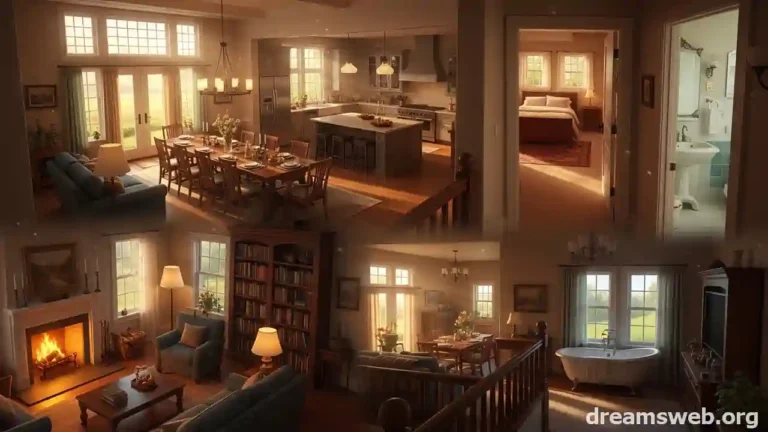
You walk through the front door without hesitation. You know exactly where the hallway leads, which step on the staircase creaks, and what the light looks like in the back bedroom at a certain hour. Yet you have never stood in this house before. Not once. Not in waking life.
You wake up quietly unsettled — not frightened exactly, but aware that something just happened in your sleep that does not follow the rules you understand. The familiarity felt too precise to be random. The rooms were too real. And somewhere in the space between sleep and morning, you find yourself asking: What does it mean to dream of a house you’ve never been to but knew every room?
This experience is more common than most people realise. It sits in a particular category of dream — one that carries weight, lingers past breakfast, and gently refuses to be dismissed. If you have had this dream, there is a reason you are still thinking about it.
What Does It Mean to Dream of a House You’ve Never Visited
In the world of depth psychology, a house in a dream is rarely just a house. It functions as one of the most consistent and widely recognised symbols in the entire vocabulary of the sleeping mind — a representation of the self. Each room corresponds to a different layer of your psyche: your thoughts, your memories, your fears, your desires, the parts of yourself you visit often and the ones you have quietly sealed shut.
When you dream of a house you’ve never been to but knew every room, the detail that matters most is not the house itself. It is that inexplicable recognition — the knowing without having learned. That is where the psychological significance lives.
Dream therapists and analysts who work within a depth framework often describe this as the subconscious presenting you with an internal map. Not a map of a building, but a map of who you are beneath the surface. The rooms you move through, the doors you open or avoid, the atmosphere of each space — all of these carry interpretive weight.
Why Your Brain Builds Familiar Rooms in Unfamiliar Places
The sleeping brain does not invent purely at random. It draws on vast reservoirs of stored imagery — places you glimpsed in photographs, architecture absorbed from films, spatial layouts your mind quietly catalogued without conscious effort. These fragments are reassembled during REM sleep into environments that feel wholly new yet retain an uncanny sense of coherence.
This process is sometimes called oneiric confabulation — the mind’s tendency to construct plausible, emotionally resonant surroundings from scattered perceptual data. The result is a place that feels like somewhere you have always known, even though no such place exists in your waking geography.
But the architecture is not arbitrary. The specific rooms your dreaming mind constructs — their size, their mood, their contents — tend to mirror the emotional landscape you are currently navigating. A wide, sun-filled kitchen may surface during periods of warmth and communal feeling. A locked room you cannot enter might reflect something you are not yet ready to face. A vast, empty hallway might speak to a transitional period in your life where you are between one chapter and the next.
When the house feels known before you have explored it, some researchers and Jungian analysts suggest this may reflect the deeper self recognising its own architecture — as though the unconscious is showing you, room by room, a version of yourself that your waking mind has not yet fully met.
The Hidden Self: Rooms in Dreams as Parts of Your Mind
Carl Jung wrote extensively about the house as a symbol of the psyche. In his own autobiographical account, he described a series of recurring house dreams that ultimately led him toward developing his theory of the collective unconscious — the idea that beneath our personal unconscious lies a shared, inherited stratum of human experience expressed through universal symbols.
Within Jung’s framework, each floor of a dream house corresponds to a different layer of psychological depth. The upper floors tend to represent conscious life — the part of yourself you are aware of and inhabit daily. The ground floor holds instinctive drives and suppressed emotions. The basement, if present, descends into the deepest regions of the unconscious — the ancient, pre-personal material that makes up the shadow self.
When you dream of a house you’ve never been to but knew every room, and you navigate it without confusion, a Jungian reading would suggest that you are engaging in a form of psychic integration. You are moving through aspects of your inner life — perhaps ones you have been neglecting, or ones that are newly accessible to you — with a readiness that your waking self may not yet have acknowledged.
This is not something to be alarmed by. It is, in many cases, something quietly hopeful.
When Dreams Feel Like Memories That Never Actually Happened
One of the most disorienting qualities of this type of dream is what psychologists sometimes call pseudomnesic familiarity — the feeling that you are remembering something you never actually experienced. You move through rooms you have never entered, open drawers you have never touched, and yet your body in the dream moves with the ease of long habit.
This is distinct from déjà vu, though it carries a similar emotional texture. In waking life, déjà vu is a brief, passing flicker. In the dream, the familiarity is sustained, detailed, and deeply convincing. It does not feel like imagination. It feels like recall.
For many people who experience this dream, the emotional tone on waking is one of mild grief — a mourning for a place that does not exist, a home that feels lost rather than never possessed. That particular ache is worth paying attention to. It may point toward an unmet longing: for belonging, for rootedness, for a version of your life that feels like yours in a deeper way than your current circumstances allow.
Others wake from this dream with a strange, expansive sense of freedom — as though they discovered a room inside themselves they did not know was there, and found it comfortable, even beautiful.
Common Emotions People Feel During This Type of Dream
Fear and Unease
Not all house dreams carry warmth. For some, the familiarity of the unknown house produces a rising anxiety — the sense that knowing every room is somehow wrong, that they should not be here, that something is waiting to be discovered that they are not prepared for. This form of the dream often surfaces during periods of identity dissonance, when who you are presenting to the world is misaligned with who you are beneath the surface.
The fear in this dream is rarely about danger in the conventional sense. It is closer to exposure — the quiet dread of being fully seen, even by yourself.
Happiness and a Sense of Return
Others describe the experience as deeply comforting — almost euphoric. The house feels like somewhere they have always wanted to live, and the knowing of it feels like a gift. This version of the dream tends to arise during periods of emotional alignment, creative expansion, or meaningful psychological growth. It may signal that you are becoming more comfortable with who you are, accessing parts of yourself that were previously hidden or suppressed.
There is something in this version of the dream that feels like homecoming, even though the house is entirely unknown.
Shame and the Closed Rooms
Sometimes the dreamer knows every room except one. A door that will not open. A room they sense is there but cannot enter. On waking, the predominant emotion is a quiet shame — not about anything specific, but a diffuse sense that something is being kept from them by their own inner architecture.
This motif is one of the most commonly discussed in psychoanalytic dream therapy. The closed room is understood to represent material the dreamer is not yet ready to integrate — perhaps a grief unprocessed, a truth unacknowledged, or an aspect of the self that has been deemed unacceptable and sequestered away.
The shame does not mean the room holds something monstrous. More often, it holds something tender.
A Sense of Quiet Freedom
Some versions of this dream carry an almost wordless liberation. You walk through the rooms with ease. The house is large and light fills it well. You feel, in a way that is difficult to articulate on waking, that you belong to yourself completely. This emotional signature is often associated with periods of psychological integration — when the self becomes more cohesive, more honest, more at home in its own complexity.
Positive Meanings Hidden Inside This Disorienting Dream
You Are Ready for Inner Exploration
The fact that you know every room — even before you have entered them — suggests a readiness. Your subconscious mind is not showing you a place you are afraid of. It is showing you a place you are equipped to move through. This is often a signal from the deeper self that you are at a point in your psychological development where something new can be known, owned, and integrated.
Dream therapists working within humanistic frameworks often view this dream as one of the most affirming experiences a person can have in sleep — a sign that the unconscious and the conscious self are moving toward each other rather than apart.
Your Identity Is Expanding
Navigating an unfamiliar house with ease can reflect a broadening sense of self. You may be growing into aspects of your character that previously felt out of reach. New capacities, new perspectives, new emotional territories are becoming accessible. The house your mind has built is a map of this expansion.
This is particularly common during meaningful life transitions — the aftermath of grief, the beginning of a committed relationship, a creative breakthrough, or simply a period of sustained inner work.
Hidden Resources Are Coming Into View
In some interpretive traditions, rooms in a dream house represent resources — capabilities, memories, relational capacities — that belong to the dreamer but have been lying dormant. To know every room of this house is to sense that these resources are already yours. You have not lost access to them. You have simply not visited them recently.
Negative Interpretations Worth Sitting With
A Longing for a Life Not Yet Lived
The feeling of knowing a house you have never visited can sometimes carry the quiet weight of a life you have not yet created. If the dream produces a lingering sadness — an ache for a place that does not exist — it may be surfacing an unexpressed yearning: for stability, for a home that genuinely feels like yours, for circumstances that better reflect your inner sense of who you are.
This is not a warning. It is an invitation to look honestly at the gap between where you are and where some part of you wants to be.
Unprocessed Memories Seeking Recognition
For some dreamers, particularly those who have experienced displacement, loss of a childhood home, or disrupted early attachments, the house dream can be the subconscious mind’s way of constructing a space that should have existed but did not. The familiar-but-unvisited house becomes a surrogate for something that was never provided in waking life.
If this resonates, it may be worth exploring with a qualified therapist. Not because the dream signals damage, but because these kinds of psychic constructions often point toward unmet needs that, once named, can begin to be addressed.
Avoidance Wearing the Costume of Familiarity
Occasionally, the sense of knowing every room is a form of psychological shorthand — the dreaming mind creating a feeling of mastery over a situation that, in waking life, the dreamer has not truly explored. If you dream of a house you’ve never been to but knew every room, and on waking you feel a subtle pride or satisfaction that quickly dissolves, it may be worth asking: is there an area of your life where you feel certain without having truly examined it?
The Jungian analyst Marie-Louise von Franz wrote about this tendency — the way the unconscious can, in certain configurations, reflect our assumptions about ourselves back at us rather than reveal something genuinely new.
Is This Dream Trying to Tell You Something About Your Life
Almost certainly, yes. But not in the prescriptive, prophetic sense that popular dream mythology sometimes suggests. The message is not located in some external event that is coming. It is located in your present inner world.
Pay attention to the emotional register of the dream. The rooms that felt welcoming. The rooms that made you hesitate. The quality of the light. Whether the house felt inhabited or empty. Whether you were alone or sensed someone else’s presence. All of these details are the vocabulary your subconscious is using to communicate something it cannot express in daylight language.
A useful practice recommended by many dream therapists is to sit quietly after waking and revisit the dream without trying to interpret it immediately. Simply allow yourself to feel it again. Notice which room stays with you. Notice what the knowing felt like in your body. These somatic clues are often more informative than any symbolic system.
This kind of self-inquiry shares common ground with what happens when you dream your voice won’t work when you try to speak — both experiences point toward unexpressed interior material that has been waiting, quietly and patiently, for your attention.
How Recurring Unknown Houses Show Up Across Different Ages
The house dream does not belong to one stage of life. It surfaces across the full span of human experience, though its character tends to shift with age.
In younger adults, the unfamiliar-but-known house often reflects the early process of identity formation — the self beginning to encounter its own complexity for the first time. The rooms may feel exciting, even thrilling, and the dreamer often explores with curiosity rather than caution.
In middle age, the same dream frequently carries greater weight. The house is larger, the rooms more distinct, and there may be spaces the dreamer has not entered in years — a quality of rediscovery, of returning to something set aside. This is consistent with what depth psychologists sometimes call the midlife individuation process, where the self begins to reclaim parts of itself that were buried in service of external demands.
In later life, the house dream often becomes more peaceful — spacious and well-lit, containing nothing threatening, holding only the quiet depth of a life fully inhabited. Some who work with elderly individuals report that this dream appears with increased frequency as a person approaches the end of life — as though the psyche is conducting a final, tender survey of all that it contains.
What to Do After You Wake From a House Dream You Recognise
There is no single correct response to a dream like this. But there are practices that many people find genuinely useful.
Write it down immediately. Not a polished account — simply the fragments, the feelings, the rooms you remember. Dream material dissolves quickly in the light of ordinary consciousness, and what feels vivid at 6am can be inaccessible by noon. The act of writing anchors the experience and creates material you can return to.
Notice what room stayed with you longest. Of all the rooms in the dream house, which one lingers in your mind after waking? This is often the room your subconscious most wanted you to visit. Its contents — its atmosphere, its objects, its emotional quality — are worth reflecting on carefully.
Ask what the house is mirroring. Given where you are in your life right now, what does this particular internal landscape say about your current state? If you find a room full of old, forgotten objects, what have you set aside in waking life that might be asking for your attention? If a room is unexpectedly beautiful and open, what part of yourself has recently come into its own?
Consider speaking with someone. Dream work does not require a professional, but having a trusted person — whether a therapist, a close friend, or a thoughtful partner — listen as you describe the dream can surface interpretations you would not reach alone. The act of narrating a dream often reveals its meaning in ways that private reflection does not.
This kind of attentive inner work bears a resemblance to the emotional labour of processing unfinished feelings in your sleep — the dreaming mind repeatedly returns to what the waking mind has left incomplete.
A Note on the Collective Dimension of This Dream
There is something worth mentioning that falls outside the purely personal. In many cultural traditions, the dream of an unknown-but-familiar house carries a transpersonal dimension — a sense that the dreamer is accessing not just their own interior life, but something larger. Some Indigenous frameworks understand these dreams as ancestral visits. Some contemplative traditions read them as encounters with archetypal space — rooms that belong not to one individual psyche but to the shared imaginative inheritance of being human.
You do not need to hold any particular belief system for this dimension to be interesting. It is simply worth noting that this dream, across cultures and centuries, has been recognised as significant — not alarming, but meaningful. Something the sleeping mind does not produce casually.
When you dream of a house you’ve never been to but knew every room, you are participating in a long human experience of interior discovery. You are not alone in having had it. And you are not wrong to take it seriously.
Frequently Asked Questions
Is it normal to dream of a house you’ve never visited but somehow know completely? Yes. This is one of the more commonly reported oneiric experiences and has been documented across cultures and throughout recorded history. It is not a sign of pathology. In most cases, it reflects the subconscious mind’s tendency to represent the self through spatial metaphor.
Does dreaming of an unfamiliar house mean something bad is going to happen? No. Dream symbolism is not prophetic in the way that popular culture sometimes suggests. The house represents your inner world, not your external future. What the dream reflects is your psychological present — your current emotional state, the parts of yourself you are exploring or avoiding, and the ongoing process of becoming who you are.
Why do I feel sad when I wake up from this dream even though it wasn’t frightening? This is one of the most commonly reported responses, and it is completely understandable. The sadness often comes from a longing for the sense of spaciousness or belonging the dream provided — a feeling of being fully at home in yourself that can be elusive in waking life. This emotional residue is worth examining gently. It may be pointing toward something you genuinely need.
What does it mean if there is one room I cannot enter in the dream? The closed or inaccessible room is a classic motif in depth psychology. It typically represents material the psyche is not yet ready to integrate — something held in reserve, not out of cruelty, but out of protection. As a general pattern, recurring closed-room dreams tend to resolve over time as the dreamer becomes more willing or able to face whatever the room holds. Working with a therapist can accelerate this process considerably.
Can this dream recur, and what does repetition mean? Yes, recurring house dreams are common. Repetition generally signals that the message the dream is carrying has not yet been received or integrated by the waking self. The dreaming mind is patient. It will continue constructing the same architecture until something in the dreamer’s conscious life shifts to acknowledge what is being shown.
Much like recurring anxiety dreams that replay unresolved pressure, the house you know without having visited will keep appearing in your sleep until the waking version of you is ready to meet what it contains. That is not a threat. That is the subconscious working faithfully on your behalf.
The house is already inside you. It has been there for a long time. The dream is simply the moment you finally walked through its door.
#dreamed of a house you've never been to #familiar house dream interpretation #house dream psychology #unknown house dream meaning

