
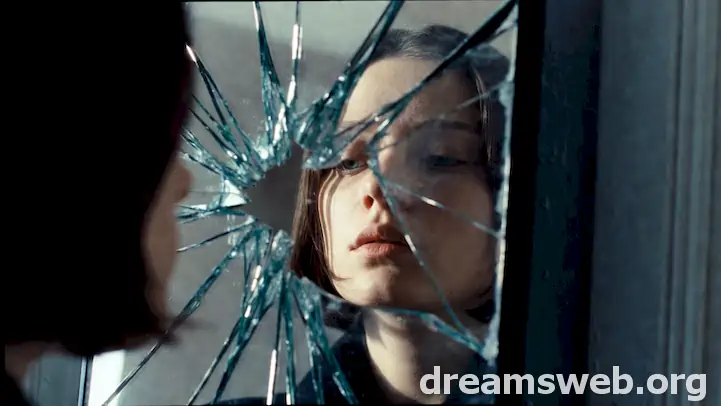
That shattering sound. The scattered shards. The uneasy feeling that follows you into the morning. When you wake from a dream like this, something tells you it was not simply noise — and you are probably right.
Most of us have heard the superstition: break a mirror and seven years of misfortune follow. But when the mirror shatters inside a dream — not in your kitchen or hallway, but in the quiet theater of your sleeping mind — the meaning runs considerably deeper than folklore. Dreaming of a broken mirror is one of the most symbolically loaded experiences the subconscious can produce, and yet it is one of the most frequently misread.
This article is not a quick-scroll list of “possible meanings.” It is a genuine, layered exploration of what this particular dream image is doing, why it shows up when it does, and what your inner life might be trying to surface through it. Whether you experienced the dream once or have returned to it multiple times, the interpretation ahead is built for you.
Why Your Brain Picks a Mirror to Signal Stress
Dreaming of a broken mirror typically signals a disruption in self-perception, unresolved inner conflict, or a transitional period in your identity. It may reflect fear of bad luck rooted in cultural superstition, but psychologically it points to fragmented self-image, anxiety around change, or the subconscious release of suppressed emotional tension.
The sleeping mind is not random. Every image it reaches for has been selected from a vast internal archive of associations — personal, cultural, neurological. So when your dreaming self finds itself standing before a shattering mirror, the first question worth asking is: why a mirror, specifically?
Mirrors are perhaps the most psychologically loaded objects in the entire domestic landscape. They are, in the most literal sense, instruments of self-appraisal. We look into them to assess, to judge, to confirm or revise our image of ourselves. From early childhood, the mirror is the first place most of us consciously encounter our own face as something separate — something we can observe. Developmental psychologists sometimes call this the mirror stage: the moment a child first recognizes their own reflection and begins constructing a distinct sense of self.
When that mirror breaks in a dream, the psyche is not just staging spectacle. It is addressing the mechanism of self-perception directly. Something in your relationship to your own image — your identity, your self-concept, your sense of continuity — has undergone or is approaching a significant fracture.
Stress, in particular, has a well-documented relationship with dream imagery that centers on breakage, collapse, and fragmentation. The brain under chronic stress tends to generate oneiric content that dramatizes the felt sense of being under pressure: things that were whole becoming broken, things that were stable becoming uncertain. The mirror is the perfect vessel for this. It is simultaneously transparent (honest, direct) and fragile (easily destroyed). When your stress becomes too compressed to process through ordinary cognition, the sleeping brain reaches for the most viscerally accurate metaphor available.
“The mirror does not lie — and that is precisely why its breaking feels so catastrophic. The dream is not announcing external disaster. It is staging an internal reckoning.”
The 7-Year Curse: Folklore Your Subconscious Kept
Long before psychology arrived to give dreams a clinical vocabulary, people were assigning meaning to broken mirrors through the language of superstition and folk belief. The most enduring of these — the seven years of bad luck — has roots stretching back to ancient Rome, where mirrors were believed to reflect not just the face but the soul. To shatter a mirror was to damage a piece of the soul’s visible form.
What is fascinating, from a dream-analysis perspective, is how deeply this cultural residue has been absorbed into the collective unconscious. Even people who have never consciously believed in the seven-year curse carry its emotional imprint somewhere in their symbolic vocabulary. When dreaming of a broken mirror evokes a visceral dread that feels disproportionate to the act itself — a mere object breaking — that dread is often being fueled by inherited cultural memory rather than personal experience.
Different cultures have interpreted the broken mirror with different specific valences. In Eastern European folk tradition, breaking a mirror during a wedding is considered catastrophic — a shadow over the union. In certain African diasporic spiritual practices, mirrors are used as liminal objects: gateways between the living world and the realm of ancestors. A shattered mirror in these frameworks represents a disrupted connection, a severed line of spiritual communication.
Hindu cosmological thought associates mirrors with maya — illusion, the veil of perception that separates the experiencing self from deeper reality. A broken mirror in this context might represent the piercing of that veil: not catastrophe, but revelation. The shattering is the point.
Understanding these cultural sediment layers matters for dream interpretation because your subconscious does not exist in a cultural vacuum. It has absorbed the symbolic grammar of the traditions you grew up in, the stories you were told, the superstitions your family carried. When your sleeping mind chooses a broken mirror as its central image, it is drawing on all of that — and the emotional charge you feel upon waking is shaped by those layers as much as by your personal psychology.
When the Glass Breaks Mid-Dream: What It Feels Like
There is something worth slowing down on before moving into interpretation: the sensory and emotional texture of the breaking event itself. Not just what breaks, but how it breaks — and crucially, what you feel in the moment it happens.
Dream researchers who study the phenomenology of nocturnal experience note that the emotional signature of a dream event is often more diagnostically significant than the symbolic content. Two people can both dream of a mirror shattering and emerge with entirely opposite psychological readings, because one experienced it with dread and the other with unexpected relief.
Consider these contrasting scenarios. In the first, the mirror breaks without warning — a sudden, sharp crack that sends the dreamer stumbling backward, heart racing, fragments scattering across the floor. The emotional residue is one of violation, exposure, something irreversible having occurred. In the second, the dreamer deliberately breaks the mirror: places a hand against it and pushes, watches it fall, stands in the silence that follows with something close to satisfaction. Same image, entirely different psychological terrain.
Pay attention also to what you did — or tried to do — after the mirror broke. Did you attempt to gather the pieces? That impulse toward repair is telling. Did you find yourself unable to look away from your own refracted reflection in the shards? That compulsion to observe a fractured self-image even in its damaged state is a remarkably common detail in these dreams, and one that carries its own weight.
The sound, too, is worth noting. Many dreamers describe the sound of the breaking as disproportionately loud — almost seismic — in a way that felt more like an internal event than an external one. The crash, in these cases, is the sound of something finally releasing. The subconscious equivalent of a pressure valve giving way.
Self-Image Cracks: What Shattered Mirrors Reveal
At the symbolic heart of dreaming of a broken mirror lies a question about identity — specifically, about the gap between the self you present and the self you privately know yourself to be.
In Jungian analytical psychology, the mirror is associated with the persona: the carefully constructed mask the ego maintains for social navigation. Most of us wear several of these simultaneously — the professional persona, the familial persona, the social persona. They are not dishonest, exactly, but they are selective. They emphasize certain aspects of the self while keeping others backstage.
When the mirror shatters in a dream, it is often the persona that is fracturing. The curated self-image — the version of you that has been presented, maintained, and relied upon — is no longer holding its form. This can happen for several reasons. A life event may have exposed the distance between persona and authentic self in a way that can no longer be ignored. A relationship may have demanded a level of self-disclosure that the persona was not designed to accommodate. Or the dreamer may simply have reached the natural exhaustion point of a performance that has been sustained too long.
It is worth noting that the fragmentation of the mirror does not destroy the image — it multiplies it. Each shard still reflects a portion of the face. This is a subtle but important detail. The broken mirror dream rarely represents the obliteration of identity. More commonly, it represents the multiplication of self-images: the forced confrontation with the fact that you are more complex, more contradictory, and less neatly unified than the single coherent reflection you have been presenting.
This connects naturally to the broader symbolic landscape explored in broken glass dreams and their spiritual and psychological signs — where the fracture of a transparent surface consistently points toward the collapse of carefully maintained illusions, and the emergence of something rawer and more authentic beneath.
Is It Fear of Judgment or Just a Bad Night’s Sleep?
One of the more practical questions people bring to dream interpretation is the simplest: does this dream actually mean something, or did I just eat too late and generate random neural noise?
The honest answer is that not every dream carries deep symbolic weight. The brain during sleep is engaged in multiple simultaneous processes — memory consolidation, emotional regulation, threat simulation, creative problem-solving — and some of the imagery generated in those processes is genuinely incidental. A broken mirror could, in principle, be a fairly shallow product of a stressful day and an overtaxed nervous system.
That said, certain features reliably distinguish a merely incidental dream from one that carries genuine subconscious freight. Emotional intensity is the primary marker. If you woke with a feeling that persisted — unease, sadness, relief, inexplicable dread — the dream was processing something with enough emotional charge to leave a somatic residue. That charge does not come from nowhere.
Recurrence is the second marker. A broken mirror that appears once might be incidental. A broken mirror that returns across multiple nights, or across weeks and months, is not random noise. It is the subconscious persisting with something it has not yet received sufficient acknowledgment for.
The third marker is specificity. Generic dream imagery tends to dissolve quickly upon waking. But the broken mirror dream that stays with you — where you can still see the particular quality of light on the shards, still hear the exact timbre of the breaking, still feel the specific emotional atmosphere of the room — has been encoded with the kind of detail that indicates emotional salience during the dream’s generation.
If two or more of those markers are present: intensity, recurrence, specificity — this is not a sleep artifact. This is a message worth taking the time to read.
How Grief, Burnout, and Change Show Up as Shards
Certain life circumstances appear with notable consistency in the personal histories of people who report broken mirror dreams. Understanding these correlations does not reduce the dream to formula — context always matters — but it does offer useful orienting information.
Grief is perhaps the most reliable trigger. Not only the grief of bereavement, but the subtler, less socially recognized forms of loss: the end of a long relationship, the departure from a career that defined you, the conclusion of a chapter of life you did not fully choose to close. The broken mirror externalizes the inner experience of losing a stable self-image. When a significant attachment ends, the self-concept that was organized around that attachment must also reorganize — and the dreaming mind often dramatizes that reorganization as a fragmentation event.
Burnout presents a different but equally consistent trigger. The person in the advanced stages of occupational or emotional exhaustion has been maintaining a particular self-image — capable, competent, holding things together — at increasing personal cost. The broken mirror dream in this context frequently arrives as a kind of somatic alarm: the persona is no longer sustainable. Something has to give. The shattering is the warning signal.
Major life transitions — moving between life stages, cultural dislocations, profound changes in relational status or professional identity — create exactly the kind of self-concept instability that the broken mirror symbolically represents. The person standing in front of a shattered mirror in their dream may be, in waking life, someone who is genuinely unsure of who they are becoming, and who is processing that uncertainty through the only channel available during sleep.
Much like the emotional turbulence that surfaces in dreaming of an empty house — where the stripped-down interior mirrors a self in the middle of identity reorganization — the broken mirror dream tends to arrive at precisely the moments when our sense of self is being asked to change more quickly than conscious adaptation can manage.
Cultural Lenses: East vs. West on Broken Mirror Dreams
Dream interpretation is never culturally neutral. The symbolic vocabulary that a sleeping mind reaches for is drawn from the specific cultural sediment the dreamer has absorbed, and interpretive frameworks vary considerably across traditions.
In Western psychological traditions — shaped primarily by Freudian and Jungian frameworks — the broken mirror is read through the lens of individual psychology. It speaks to the personal history of the dreamer: their self-image, their ego structure, their relationship to their own reflection in both the literal and figurative sense.
Chinese classical dream interpretation, drawing on Taoist and Confucian frameworks, tends toward a more relational reading. In the Tang dynasty dream manual Dunhuang Zhanmeng Shu, mirrors feature as emblems of family unity and marital fidelity. A broken mirror in this tradition — echoing the classic idiom 破镜重圆 (a broken mirror made whole again) — often signals the separation of lovers or the dissolution of a close bond, with the possibility of eventual reunion embedded in the image itself.
In Japanese folk tradition, mirrors hold a distinctly sacred status. The sacred mirror Yata no Kagami is one of the three Imperial Treasures of Japan, and mirrors generally function in Japanese symbolism as vessels of the divine — objects that hold truth and protect against malevolent spirits. A broken mirror in a Japanese dream context carries a far more serious spiritual charge than the Western “bad luck” interpretation suggests.
Indigenous Latin American curanderismo traditions tend to read the mirror as a protective shield. When it breaks, the protection has been either removed, exhausted, or no longer required. The absence of the shield does not necessarily signal danger — sometimes it signals that the dreamer has outgrown the need for that particular form of protection.
What is striking, surveying these diverse interpretive traditions, is how rarely the broken mirror is read as purely inauspicious. Disrupted, yes. Transformative, almost always. But the cultural wisdom embedded in widely different traditions consistently suggests that the breaking is a threshold, not a terminus.
When Shattering Glass Actually Signals a Fresh Start
Here is the reading that catches most people off-guard: dreaming of a broken mirror can be, in the right context, one of the more optimistic dreams a person can have.
This requires a small shift in perspective — one that moves away from the superstitious framing (shattering as misfortune) and toward the psychological one (shattering as release). Consider what a mirror actually does. It holds a fixed image. It returns the same reflection with reliable consistency. When you are growing, changing, shedding an outdated version of yourself — that fixity becomes a liability. The mirror that used to show you accurately has become an instrument of stagnation.
When it breaks, the fixed image breaks with it.
Dreamers who report broken mirror experiences with positive emotional signatures — relief, lightness, a sense of something finally resolved — are often people standing on the threshold of genuine transformation. The persona has been ready to dissolve. The self-concept has been quietly outgrown. The dream simply provides the ceremonial release: a sensory event to mark what has already, at a deeper level, occurred.
There is a strand of somatic dream work — associated with practitioners like Arnold Mindell — that views destructive dream events as the psyche’s method of enacting necessary releases. The breaking, the collapse, the dissolution of form is not destructive in any final sense. It is the prerequisite for new form. The mirror must shatter before the dreamer can encounter themselves without the mediation of fixed reflection.
If your broken mirror dream left you feeling, unexpectedly, lighter — pay attention to that. The subconscious is not always delivering news about loss. Sometimes it is delivering news about freedom.
How to Stop Repeating This Dream and What to Do Next
If the broken mirror dream has become a recurring visitor, the question most people eventually reach is: how do I make it stop? And the honest answer is that the most effective way to stop a recurring dream is not to suppress it, but to hear it.
Recurring dreams are persistent precisely because the psychological or emotional content they are attempting to process has not yet been sufficiently acknowledged in waking life. The subconscious is not stubborn; it is thorough. It will keep returning to the unaddressed material until the material has been given the attention it requires.
The most practical first step is a dream journal — not a diary, but a dedicated space for capturing dream content immediately upon waking, before the imagery fades. Record not just the events of the dream but the emotional texture: the specific quality of the fear or relief or sadness, the bodily sensations that accompanied it, the details that feel strangely significant even when you cannot yet explain why.
Second: identify the waking-life correspondence. Ask directly — what in my current life feels most like a broken reflection? Where is my self-image under pressure? What have I been presenting to the world that feels increasingly out of alignment with what I actually know to be true about myself? These questions are sometimes uncomfortable to sit with, but they are the questions the dream is already asking. Answering them consciously reduces the necessity of the dream repeating the question in your sleep.
Third, consider whether the dream might be pointing toward something that requires external support. If the emotional charge of the dream is connected to grief, relational rupture, professional burnout, or a sustained sense of identity fragmentation, those are experiences that benefit from more than self-reflection alone. A skilled therapist, particularly one with background in depth psychology or somatic approaches, can help navigate the terrain that the dream is mapping.
Finally, there is value in developing what some practitioners call a dream response ritual — a brief, intentional practice that bridges the dream space and the waking one. After a broken mirror dream, this might be as simple as looking at your reflection deliberately in the morning, acknowledging the complexity you see there, and offering yourself a small gesture of self-recognition. The mirror is not the enemy. It is the instrument through which you are learning to see yourself more honestly.


Leave a Reply