


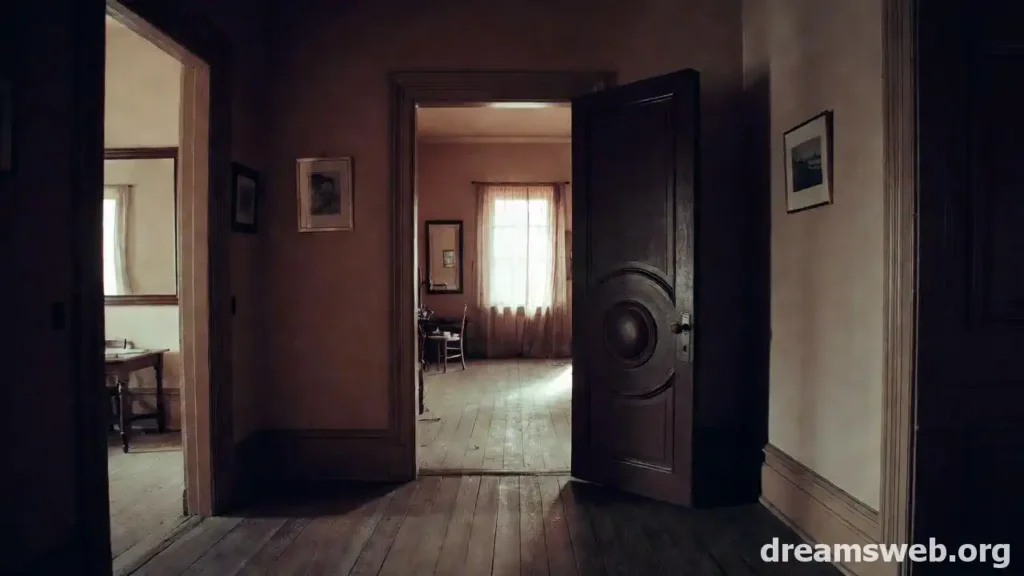
Dreaming of an empty house typically reflects a sense of emotional vacancy, personal transition, or unexplored aspects of the self. The house symbolizes the dreamer’s inner world — and its emptiness may signal grief, fresh beginnings, identity shifts, or a subconscious invitation to examine what truly needs filling in your waking life.
You wake up, and the image lingers. A house — perhaps one you recognize, perhaps one you have never stepped inside — standing completely bare. No furniture. No voices. Just hollow rooms and the quiet echo of your own footsteps. The feeling it leaves behind is difficult to name. Not quite sadness. Not quite peace. Something older than either.
That feeling is worth paying attention to. Because when the dreaming mind places you inside an empty house, it is rarely talking about architecture.
It is talking about you.
“The house in a dream is one of the oldest symbolic containers the psyche uses — a living map of the self, drawn in walls and shadows.”
Whether you experienced this dream once or have returned to it repeatedly, this guide will walk you through its layered meanings — emotionally, psychologically, and spiritually. No abstract jargon, no sweeping generalizations. Just an honest look at what your sleeping mind may be trying to surface.
Why Your Brain Builds Empty Houses at Night
Dreams are not produced randomly. Every symbol your sleeping mind generates has a purpose, even when that purpose feels obscured. The house, in particular, is one of the most enduring and cross-culturally consistent symbols in the entire landscape of nocturnal imagery.
Across cultures and centuries, the house has functioned as a somatic metaphor — a structure that mirrors the dreamer’s physical body, emotional architecture, and internal sense of safety. When Sigmund Freud first mapped the relationship between dwelling imagery and selfhood, he noted that rooms often correspond to emotional compartments: things hidden, things forgotten, things we no longer visit.
But what happens when those rooms are stripped bare?
The brain, during REM sleep, actively sorts emotional residue. It replays unresolved conflicts, tests hypothetical futures, and creates symbolic narratives around feelings that have not yet been consciously processed. An empty house dream, then, is not a sign that something is wrong. It is a sign that something is in motion — that a cycle of internal reorganization is quietly underway.
Here is the part most dream dictionaries miss: emptiness in a dream is not the same as loss. Sometimes it is the precondition for something entirely new.
The House in Dreams as a Mirror of the Self
In the framework of depth psychology — especially the work of Carl Jung — the house is one of the most potent representations of the psyche itself. Each floor can correspond to a different level of consciousness. The basement is often where the shadow lives: the repressed, unacknowledged material we have not yet chosen to face. The upper floors might represent aspiration, spiritual longing, or idealized versions of the self. The ground floor, where daily life unfolds, mirrors the ego’s functional surface.
An empty version of this structure carries a particular kind of weight. There is nothing to distract you. Nothing to rearrange, no furniture to move, no rooms filled with the accumulated clutter of unresolved experience. You are standing inside yourself — and what you encounter is space.
That space can feel liberating or terrifying depending on where you are in life.
Consider Elena, a woman in her early forties who began dreaming of her childhood home — stripped of every piece of furniture — in the weeks following her youngest child leaving for university. The house was familiar, but its bareness was new. She described the dream as feeling like “standing inside a sentence that hadn’t been finished yet.” Her subconscious was processing a genuine identity transition: the receding of the caretaker role, and the emergence of something undefined but clearly present in the wings.
The question an empty house dream asks is not “What happened to everything?” It is “Who are you when everything is removed?”
Rooms With Nothing: What Each Space Can Signal
Not all empty rooms carry the same resonance. The specific space you find yourself standing in can sharpen the interpretation considerably.
The Empty Kitchen
The kitchen is traditionally a site of nourishment, creativity, and communal gathering. Finding it empty often reflects a sense of emotional depletion — a feeling that the inner resources you usually draw on to sustain yourself or others have been exhausted. It can also signal a period where old ways of coping or nurturing are no longer adequate, and something new has not yet taken their place.
The Empty Bedroom
The bedroom is one of the most intimate rooms in the dreamscape. When it appears devoid of furnishings, it frequently points to themes of relational longing, solitude, sexual dormancy, or a deep-seated need for restoration that is going unmet. If the bed is absent entirely — not just empty, but gone — the dream may be pointing toward a relationship or a period of life that has formally ended.
The Empty Living Room
The living room is the social chamber — the space where identity is performed for others. An empty living room can reflect a withdrawal from social engagement, a questioning of one’s public persona, or a shedding of social roles that no longer feel authentic. There is also the possibility of liberation here: removing the performance reveals what remains underneath.
The Empty Room You Cannot Identify
Sometimes the dreamer finds themselves in a room with no discernible function — an undefined space within the house. Jungian analysts often regard these as thresholds, representing undeveloped potential or unexplored aspects of the personality that have not yet been assigned a role in the dreamer’s conscious life.
The room matters almost as much as the emptiness itself. Pay attention to where in the house you found yourself standing.
Feeling Lost Inside a Familiar Empty Home
One of the more quietly unsettling variations of this dream involves a house you recognize — your childhood home, a former residence, the home of a deceased grandparent — rendered completely bare. This specificity is not accidental. The sleeping mind has chosen a location laden with personal history and stripped away all its familiar markers.
What remains is the structure itself: bones without flesh.
This type of dream often surfaces during periods of grief — not only the grief of bereavement, but the broader, less-acknowledged forms of loss that rarely receive formal recognition. The loss of a life stage, of a version of yourself, of a relationship, of a professional identity. Grief researchers sometimes call this ambiguous loss: the mourning of something that has not died in any literal sense, but is nonetheless profoundly absent.
The familiar empty house externalizes this internal experience. It gives form to a feeling that ordinary language struggles to contain.
There is also a curious strand of shadow work embedded in these dreams. The shadow — Jung’s term for the unconscious repository of rejected, denied, or unexamined aspects of the self — sometimes communicates through exactly this kind of dreamscape. The house you know has been cleared out. What are you being asked to look at now that the distractions are gone?
Much like dreaming of a locked safe, the empty familiar home asks what you have been keeping hidden — not from others, but from yourself.
When the Dream Feels Cold, Calm, or Unsettling
The emotional texture of the dream is as diagnostically significant as any symbolic element. Two people can dream of the same empty house and emerge with entirely different interior experiences. Tracking that emotional residue is often the most direct path to interpretation.
When It Feels Cold or Desolate
A cold empty house — one that carries a sense of abandonment or emotional frost — frequently corresponds to states of depression, emotional shutdown, or profound disconnection from one’s own needs and desires. The coldness is the psyche’s meteorological report: warmth — vitality, passion, connection — has withdrawn from certain areas of inner life. This is not a condemnation but a signal. The dream is marking something that needs tending.
When It Feels Calm or Spacious
Not all empty house dreams carry darkness. For many dreamers, the absence of furniture is experienced as relief — as an expansive, breathing quiet that waking life rarely offers. These dreams often correlate with genuine readiness for transition. The old contents have been cleared, consciously or otherwise, and the self stands open to new arrangements.
When It Feels Unsettling Without Obvious Reason
Sometimes the unease is ambient — present but sourceless. The house is empty, nothing specifically threatening is occurring, yet something about the atmosphere feels wrong. This liminal discomfort often points to a transitional edge: the self standing between what has been and what is not yet formed. The dream is not predicting disaster. It is mapping the territory of in-between.
How the dream feels is often more telling than what the dream contains.
Empty House Dreams During Life Transitions
Certain life circumstances are remarkably consistent in generating empty house dreams. Understanding these correlations does not reduce the dream to a predictable formula — no dream should ever be reduced to that — but it does offer useful context for interpretation.
Separation and divorce are among the most common triggers. The shared home, once full of someone else’s presence, belongings, and emotional energy, becomes architecturally altered when a partner departs. The dreaming mind often processes this alteration through a literalized image: the house as it actually feels now — vast, hollow, and unmistakably changed.
Bereavement produces similar imagery. After the death of a parent or partner, dreamers frequently report returning to the house of the deceased in their dreams, finding it empty. These dreams are not hauntings in any supernatural sense. They are the psyche doing its slow, necessary work of accommodation — learning to hold the absence.
Major identity transitions — retirement, the end of a career chapter, children leaving home, recovery from addiction, completion of a long academic or creative journey — also frequently prompt this dreamscape. The house is the self, and the self has been reconfigured. The emptiness is the resting state between configurations.
Just as dreaming of rain signals emotional processing during upheaval, the empty house arrives when the interior landscape has been disturbed enough to require symbolic attention.
What Dream Psychology Says About Vacant Spaces
Contemporary dream psychology draws on a rich lineage of thinkers — Freud, Jung, Adler, and more recently researchers like Mark Solms and Rosalind Cartwright — to illuminate why certain images repeat across individuals and cultures.
The empty house occupies a particular position in this literature because it operates simultaneously as a spatial metaphor and an identity mirror. It is one of the few dream images that can represent both loss and potential without contradiction.
From a cognitive neuroscience perspective, recurring house dreams often indicate that the hippocampus — responsible for spatial memory and emotional indexing — is working overtime. The familiar architectural structures of houses we have inhabited are among the most deeply encoded memories the brain holds. When these structures appear emptied in dreams, it often correlates with a period of significant emotional reorganization in the hippocampal memory system.
From an attachment theory standpoint, the house dream can be read as a representation of internal working models — the unconscious blueprints for how we expect relationships and safety to function. An empty house, in this reading, may reflect a disruption or revision of those models: the old template has been cleared, and the dreamer is, consciously or not, building a new one.
Your dream does not know that you are asleep. It is using every architectural detail to speak a language your waking mind is only beginning to understand.
Cultural Views on Dreaming of an Abandoned Home
The interpretation of empty or abandoned structures in dreams is not limited to Western psychology. Across diverse cultural frameworks, these images carry their own specific resonances.
In many East Asian dream traditions, particularly those influenced by Taoist and Buddhist philosophy, an empty house in a dream is regarded as auspicious — a symbol of non-attachment and the clearing of karmic residue. The emptiness is not a problem to be solved but a condition to be honored. It suggests the dreamer is undergoing a process of purification.
In certain Indigenous dream frameworks across the Americas and Africa, the ancestral home — bare and echoing — is understood as a site of spiritual encounter. The absence of physical objects is read as the presence of something non-physical: the dreams of lineage, the unfinished business of ancestry, the accumulated wisdom of those who lived within those walls before you.
In Latin American folk dream interpretation, drawn largely from the curanderismo tradition, an empty house frequently signals the departure of a protective spirit or entity from one’s life. This is not necessarily read as negative — sometimes protection leaves because it is no longer needed.
What strikes the careful observer is how consistently, across radically different cultural frameworks, the empty house functions as a threshold rather than a terminus. Something is in passage. The dream marks the crossing point.
Turning the Dream Into a Tool for Self-Reflection
Dreams are most valuable not as prophecy but as dialogue. The empty house dream is an invitation to sit with certain questions that, in the pace of ordinary life, rarely receive the attention they deserve.
Begin with the most basic inquiry: whose house was it? The answer will often anchor the interpretation more precisely than any symbolic dictionary could. Your childhood home points backward, toward foundational identity and early experience. A house you have never inhabited points forward, toward possibility and what has not yet been claimed.
Next, consider: what did you feel when you walked through it? Not what you think you should have felt — what you actually felt. The emotional grain of a dream is its truest layer of information.
Then ask: what would you put in the house if you could? This question is deceptively powerful. The things you imagine returning to those empty rooms are often the things your waking life is most urgently missing — or most ready to welcome.
Practical integration practices that resonate with this type of dream include keeping a dedicated dream journal beside your bed, writing freely for ten minutes upon waking without editing or interpreting, sketching the floor plan of the house from memory, and returning to the dream in a quiet waking state — a practice known in somatic therapy as dream re-entry — to explore what the empty rooms feel like when approached with conscious attention.
“The empty house does not ask you to fill it. It asks you to be present inside it long enough to understand what it is saying.”
Whatever transition, grief, liberation, or becoming you are currently navigating — the empty house has already begun its quiet work on your behalf. Trust the architecture of your own interior. The rooms are still standing. They are simply waiting for you to decide what belongs in them now.
FAQs: Empty House Dreams and What They Mean
What does it mean to dream of an empty house in general?
Dreaming of an empty house generally reflects your inner emotional state at a given moment in life. The house symbolizes the self, and its emptiness can signal a transition, a feeling of emotional vacancy, grief, the end of a life chapter, or the quiet space between who you were and who you are becoming. The interpretation depends heavily on the emotional tone of the dream and the specific type of house you encountered.
Is dreaming of an empty house a bad omen?
Not inherently. While empty house dreams can sometimes reflect loneliness, loss, or emotional depletion, they are equally common during periods of genuine renewal and liberation. The dream is rarely predictive in the sense of foretelling misfortune. It is more accurately read as a snapshot of your current inner landscape — and landscapes, by nature, are always changing.
Why do I keep dreaming about an empty version of my childhood home?
Recurring dreams of a bare childhood home typically indicate that some aspect of your foundational identity — the self shaped by early experience — is undergoing revision. This is common during major life transitions, periods of grief, or times when old beliefs and coping patterns are being consciously released. The familiar structure stripped of its familiar contents is the psyche’s way of asking: who are you beneath the earliest version of yourself you were taught to perform?
What does it mean to dream of an empty house that feels peaceful?
A peacefully empty house is one of the more optimistic configurations of this dream. It often corresponds to a felt sense of readiness — the previous chapter has been genuinely completed, emotional clutter has been cleared, and the dreamer stands at a genuine threshold without anxiety. Many people report this dream in the wake of successful therapy, meaningful spiritual practice, or the natural conclusion of a long and demanding life season.
Can an empty house dream be related to fear of loneliness?
Yes, though it is worth distinguishing between loneliness and solitude in the dream context. If the empty house dream carries a tone of desolation, yearning, or abandonment, it may well be processing unexpressed fears around isolation or relational loss. However, if the emptiness feels spacious and still rather than hollow and cold, the dream may be pointing toward a healthier relationship with solitude — one the dreamer is either cultivating or being invited to cultivate.