


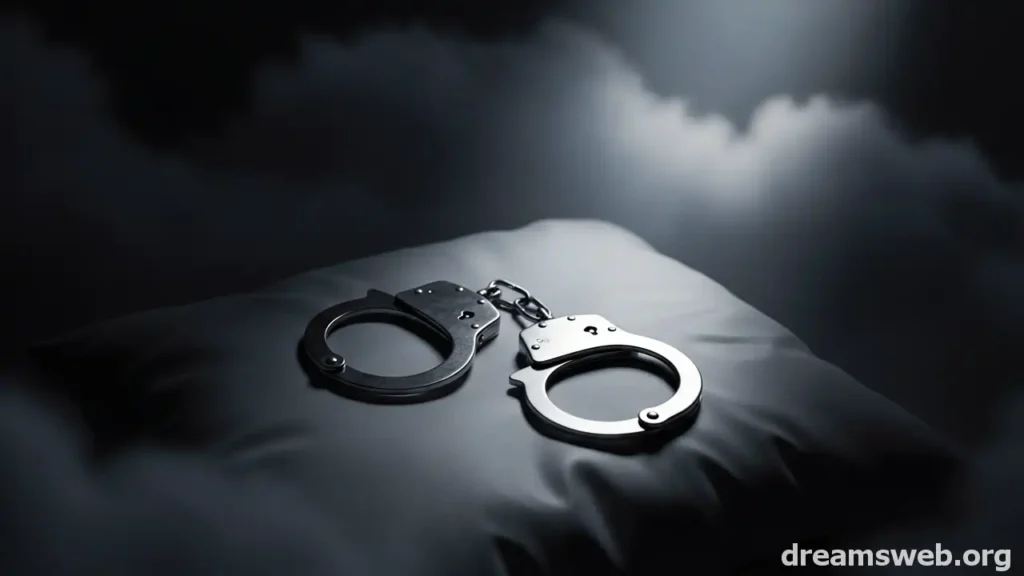
What does dreaming about handcuffs mean?
Dreaming of handcuffs often signals an inner conflict between personal freedom and perceived obligation. Psychologically, it reflects feelings of guilt, suppressed will, or self-imposed limitation. Spiritually, it may indicate a soul calling for release. Whether the restraint feels threatening or strangely comforting depends entirely on the emotional tone of the dream itself.
You wake up with a strange weight on your wrists — even though they are completely free. The image lingers: handcuffs. Cold metal. A sense of being held. And somewhere beneath that image, a feeling you cannot quite name.
Handcuffs in a dream are among the most emotionally loaded symbols a sleeping mind can produce. They appear in the dreams of people who are quietly exhausted by invisible obligations, by rules they wrote for themselves long ago, and by a version of obedience they never consciously chose. They also appear in the dreams of people who are processing real experiences of loss, control, or shame.
This is not a simple symbol. It deserves a careful and unhurried reading.
What Does It Mean to Dream About Handcuffs?
A handcuffs dream sits at the intersection of two very human fears: the fear of punishment and the fear of being unable to move forward. Both are worth sitting with. In most recorded dream analyses — from classical psychoanalytic traditions to more contemporary cognitive frameworks — objects of restraint consistently point to a perceived loss of agency in waking life.
But the handcuffs themselves are not simply a sign of external force. In many cases, they represent something the dreamer has constructed internally — a belief system, a set of self-imposed rules, or an identity so rigidly defined that any deviation from it feels like transgression.
When interpreting a handcuffs dream, the first and most essential question to ask is: who put them on? And did you let them?
The Psychology Behind Feeling Trapped in Dreams
From a psychological standpoint, dreaming of being restrained belongs to a broader category of what researchers call constriction dreams — nocturnal narratives in which the body or will is impeded. These are remarkably common and tend to cluster during periods of sustained stress, major life transitions, or prolonged suppression of desire.
The role of the subconscious mind
Carl Jung, whose work on the symbolic language of dreams remains foundational, believed that the sleeping mind speaks in archetypes — universal symbols drawn from the collective unconscious. Restraint, in the Jungian framework, often manifests as a confrontation with what he called the Shadow: the suppressed, disowned parts of the self that demand recognition.
When you dream of being in handcuffs, your subconscious may be surfacing a tension that your waking mind has carefully avoided. The handcuffs are not your enemy in this reading — they are a mirror. They are asking: which part of yourself have you been locking away?
Cognitive-behavioral perspectives
From a more behaviorist standpoint, recurring constriction dreams are often linked to what psychologists describe as autonomy threat — the sense that one’s freedom to choose, act, or express is being compromised. This can arise from an overbearing professional environment, a relationship with highly asymmetrical power dynamics, or an internalized inner critic that monitors and punishes every impulse before it reaches the surface.
Dream therapists frequently note that clients who experience handcuffs dreams are often high-functioning individuals who present as composed and in control by day — yet whose inner architecture is quietly strained by self-regulation that has long since crossed the line from discipline into self-suppression.
“The most binding chains are the ones we can’t see — because we built them ourselves, one reasonable rule at a time.”
Are Your Own Beliefs Holding You Back in Life?
There is a particular quality to this kind of dream that differs from nightmares about external threat. When the restraint in a dream feels oddly familiar — when part of you, even within the dream, accepts the handcuffs without much protest — that is worth noting.
Many people who report dreaming about being handcuffed describe not a feeling of terror, but something closer to a quiet, suffocating resignation. As though the handcuffs were expected. As though they had been waiting for them.
This emotional signature often correlates with a deeply ingrained set of self-limiting beliefs: I am not allowed to want too much. I should not take up space. If I stop following the rules, everything will fall apart. These beliefs rarely announce themselves. They operate below the level of conscious thought — which is precisely why they surface in dreams.
Where do these rules come from?
Developmental psychologists point to early caregiving environments as the primary source. Children who grew up in households with rigid behavioral standards, conditional love, or high levels of emotional unpredictability often develop internal compliance systems — psychological structures that enforce those same standards from within, long after the original external authority has gone.
A handcuffs dream may, in this context, be the mind’s way of finally rendering visible what has always been invisible: the self-regulating, self-punishing part of the psyche that has been quietly running the show.
Handcuff Dreams and the Fear of Losing Control
Interestingly, not everyone who dreams of handcuffs feels distressed by them. Some dreamers report a strange sense of relief upon being restrained — as though the handcuffs removed the burden of having to make choices. This is a genuinely revealing emotional response and one that dream therapists treat with particular care.
The paradox of control is well-documented in psychological literature: individuals who maintain exhausting levels of self-control in their waking lives sometimes unconsciously crave the removal of that burden. The handcuffs, in this version of the dream, are not a prison. They are permission — permission to stop being in charge.
This does not indicate pathology. It indicates fatigue. It signals that the dreamer may be carrying a disproportionate weight of self-governance — and that some part of them is asking for rest.
Fear, shame, and the emotional residue of constriction dreams
For others, the dominant emotional tone of a handcuffs dream is unmistakably one of shame. The restraint is experienced not as control or punishment from the outside but as a deserved consequence — a form of psychic sentencing. This version of the dream tends to appear in people who carry unresolved guilt, whether from actual wrongdoing or from the more pervasive, diffuse guilt that accompanies chronic people-pleasing and self-abnegation.
Fear, too, is a common emotional register — particularly fear of exposure. Being handcuffed in a public setting within a dream can reflect the terror of being seen, judged, or found inadequate. The public nature of the arrest amplifies the shame dynamic and points toward a preoccupation with social evaluation.
When Rules Become Chains: Signs You’re Self-Limiting
One of the most quietly provocative readings of a handcuffs dream is not about external circumstances at all. It is about the internal codes of conduct that many people live by without ever having consciously ratified them.
These are the unwritten statutes of the self: always be productive, never ask for help, keep your emotions contained, earn your rest, justify your existence through output. They feel like wisdom. They feel like strength. But at a certain threshold, they become a form of captivity.
How to recognise self-imposed restraint in waking life
The markers are subtle but consistent. You feel vaguely guilty when you rest. You pre-emptively shrink yourself in professional or social settings before anyone has asked you to. You have a deep-seated difficulty saying no — not from generosity, but from fear of the consequences of refusal. You find yourself constantly monitoring your own behaviour, editing your instincts before they reach expression.
If any of this feels familiar, your dream may be doing something generous: it is naming the invisible architecture. It is showing you, in unmistakable symbolic form, that you are wearing handcuffs — and that you may be holding the key.
The Spiritual Meaning of Handcuffs in a Dream
Across spiritual traditions, dreams of confinement carry a rich and layered resonance. In many contemplative and indigenous frameworks, the dream state is not merely a byproduct of neural housekeeping — it is understood as a space of genuine revelation, a threshold through which guidance and truth can pass.
A call toward liberation
In Buddhist and Vedic philosophical streams, the image of bondage in a dream is sometimes interpreted as the mind’s representation of samsara — the cycle of attachment and suffering from which liberation (moksha or nirvana) is the ultimate aim. Handcuffs, in this reading, symbolise the clinging mind: the part of the psyche that grasps at fixed identities, rigid narratives, and self-definitions that have long since stopped serving growth.
From a Christian mystical perspective, restraint in dreams has been associated with the binding of the will — a theme that recurs throughout contemplative literature on spiritual dryness and the surrendering of egoic control. Here, the handcuffs might represent not punishment but an invitation toward a deeper form of surrender and trust.
Karmic and energetic interpretations
Within more contemporary spiritually-oriented dream work, handcuffs are often read as indicators of what practitioners call soul contracts — commitments, agreements, or patterns absorbed from ancestral lineage or formative experience that continue to operate as constraints even when they are no longer necessary or true. The presence of these symbols is understood not as condemnation but as an opening: the soul, in this framework, uses the dream to signal that a pattern is ready to be released.
A spiritual director or contemplative guide working with such a dream might invite the dreamer to ask: What vow am I still keeping that I never consciously made? What version of myself am I still honouring out of loyalty rather than love?
Positive and Negative Interpretations: Both Deserve Space
The shadow side of the dream
At its most challenging, a recurring handcuffs dream can indicate a sustained and unaddressed crisis of self-determination. When the dream returns night after night with the same quality of entrapment — and when waking life carries a matching feeling of stasis, of moving through days in which real choice feels absent — it is worth treating this as a serious signal rather than random imagery.
Psychotherapists and somatic practitioners who work with the body’s memory of constraint note that habitual self-restriction is not merely a cognitive pattern. It is something the nervous system also learns and rehearses. Chronic tension in the shoulders, chest, or jaw; a persistent sense of bracing; difficulty breathing fully — these can all be somatic expressions of the same constriction that the dream is rendering symbolically.
The generative side of the dream
There is, however, a genuinely optimistic reading of this symbol — and it deserves equal weight.
Dreaming of handcuffs can be a sign of nascent self-awareness: the psyche recognising, for perhaps the first time, that certain limitations are constructed rather than inherent. The dream may be the beginning of an important inner reckoning. In the language of Jungian individuation — the lifelong process of becoming more fully and authentically oneself — this kind of dream can mark a threshold moment: the point at which the self begins to question the constraints it has internalised and to wonder what life might look like on the other side of them.
There is also a version of this dream in which the handcuffs are removed during the dream itself — or in which the dreamer discovers, with a wave of quiet joy, that they were never truly fastened. The sense of freedom that floods in during such a dream is among the most affecting emotional experiences the dreaming mind can generate. It is the feeling of a rule dissolving. Of permission finally given.
“Sometimes the dream does not show you the cage. It shows you the open door.”
Breaking Free: How to Work With This Dream
If a handcuffs dream has found its way into your sleep, the most useful response is not to dismiss it or to over-interpret it in isolation. Dreams reward patient attention and open-ended reflection more than they reward quick, conclusive readings.
Journaling as a starting point
Begin by writing the dream out in as much sensory detail as you can — not just what happened, but what it felt like. Was the metal warm or cold? Were you alone or observed? Was there a feeling of inevitability about the handcuffs, or did they come as a shock? The emotional texture of the dream is often more informative than its narrative content.
Then ask yourself: where in my waking life does this feeling live? Where do I feel similarly constrained — not by circumstances, but by my own internal code?
Working with a dream therapist or analyst
For dreams that recur or carry unusual emotional weight, working with a trained dream therapist or Jungian analyst can be genuinely valuable. These practitioners are skilled in what might be called imaginal dialogue — a process of entering back into the dream landscape through guided reflection and engaging with its symbols as though they were living presences with something to communicate.
This is not esoteric or irrational. It is a structured way of accessing the symbolic intelligence of the unconscious — an intelligence that communicates not in propositions but in images, sensations, and emotional resonances.
What Your Subconscious Is Really Trying to Tell You
At the deepest level of interpretation — beyond the particular symbols, beyond the cultural overlays and theoretical frameworks — a handcuffs dream is the psyche speaking in its most direct register about the question of freedom.
Not political freedom. Not financial freedom. The quieter, more interior kind: the freedom to be fully oneself, without perpetual self-monitoring, without the constant editing of impulse into acceptability.
The subconscious is not theatrical. When it produces an image as stark as restraint, it is usually because more subtle communications have gone unnoticed. The handcuffs are not punishment. They are an invitation — to look honestly at the rules you live by, to ask which of them still serve you, and to consider, gently and without drama, which ones might be ready to fall away.
Handcuffs as a Symbol of Guilt, Shame, or Obligation
Guilt and shame are among the most potent architects of inner constriction. They operate with extraordinary efficiency — requiring no external enforcer, no ongoing punishment, no visible prison. They simply reside within, shaping behaviour from the inside out.
When shame is the emotional register of a handcuffs dream, the image often carries a quality of public exposure: being seen in restraints, being led away, being judged. This is the dreaming mind’s representation of what psychologist Brené Brown and others in the shame-resilience field describe as the core terror of shame — the fear of being fundamentally unworthy, and of that unworthiness being made visible.
Obligation, too, deserves mention here. For many individuals — particularly those who were parentified in childhood, or who occupy caregiving roles in adult life — the sense of being bound by the needs and expectations of others is so normalised that it has become indistinguishable from identity. A handcuffs dream may, in this case, be asking a quietly revolutionary question: what would you do if you were not responsible for everyone else’s comfort?
How to Use Dream Insights to Unlock Personal Freedom
Dreams, at their most useful, function as a diagnostic tool — not a prescriptive one. They do not tell you what to do. They show you where you are. And from that more honest vantage point, meaningful movement becomes possible.
If your handcuffs dream has opened something in you — a recognition, a discomfort, a quiet surge of wanting — that is precisely the response the dream was designed to elicit. Follow it, not with urgency, but with curiosity.
Notice where in your life you have been operating from obligation rather than genuine desire. Notice the internal voice that monitors and corrects — and ask whether it is speaking wisdom or simply fear wearing wisdom’s clothes. Begin, slowly and without fanfare, to distinguish between the rules that genuinely protect you and the ones that merely confine you.
The handcuffs in the dream were never the point. The point is the key — and the growing awareness that it has been in your hand all along.
This article is intended for reflective and informational purposes. If you are experiencing recurring distressing dreams or emotional difficulty, consider speaking with a qualified mental health professional or licensed therapist.