


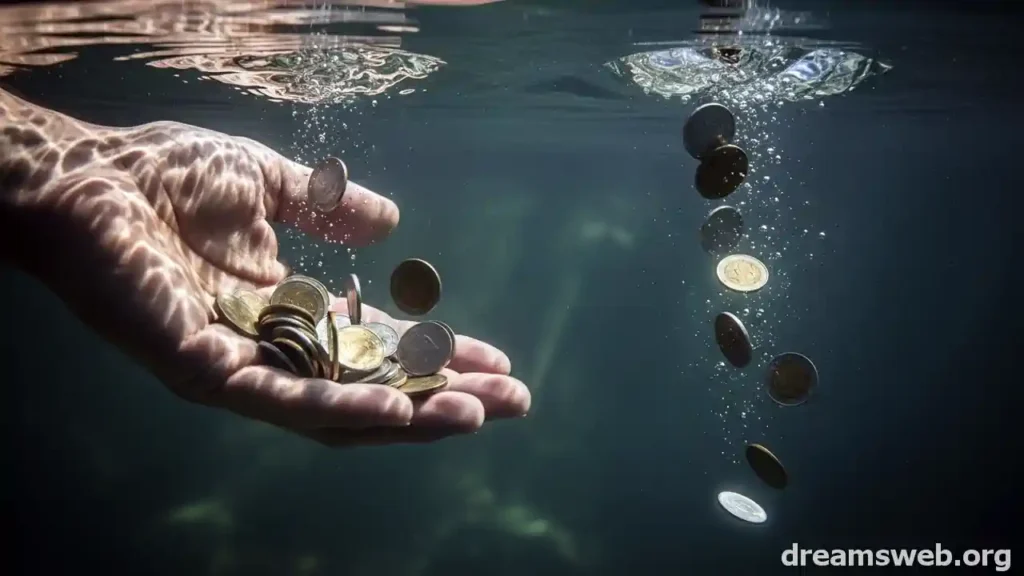
Dreaming of losing coins in water typically signals an unconscious fear of losing personal value, energy, or financial security. The water deepens the symbolism by introducing emotional undercurrents. It can reflect anxiety, spiritual release, or a subconscious nudge to examine what you are quietly letting slip away in waking life.
What It Really Means When You Drop Coins in Water
You wake up and the image lingers — coins falling, spinning, sinking slowly beneath the surface of dark or shimmering water. The feeling stays with you even after the dream ends. Something was lost. But what, exactly?
The losing coins in water dream is one of those experiences that sits in a peculiar middle ground. It feels significant without announcing why. It leaves behind a residue — sometimes unease, sometimes a strange, hollow relief — and most people find themselves turning it over in their minds long after breakfast.
Before reaching for a simple answer, it helps to understand what the dreaming mind is actually doing. The unconscious does not speak in plain language. It speaks in symbols, textures, and emotional atmospheres. Coins and water are two of the most richly layered symbols the psyche uses. Together, they form a composite image that touches something much deeper than your bank balance.
In the language of depth psychology, coins rarely refer to money in any literal sense. They represent something far more intimate: personal worth, stored potential, exchangeable energy. They are the embodied form of what you believe yourself to have — or to be losing.
And water? Water has been the universal symbol of the unconscious itself since the earliest recorded dream traditions. It is the element of feeling, of the unseen current, of things that move beneath the surface of awareness.
When you lose coins in water in a dream, you are watching something of perceived value — something you once held — descend into the emotional depths. Whether that descent is a tragedy or a liberation is something only the full context of your dream, and your waking life, can determine.
The Emotional Weight Behind Losing Something Valuable
The feeling inside the dream matters enormously. This is where most dream interpretation goes wrong — it catalogues symbols without attending to the emotional texture that surrounds them.
Consider the range of responses people report after this particular dream:
Some wake up with fear — a tight, cold anxiety in the chest, a sense that something irreplaceable has gone. This fear often points toward a real-world concern that has not been fully acknowledged. Financial insecurity. The quiet worry that opportunities are slipping past. The sense that time, which is its own kind of currency, is moving faster than you can hold onto it.
Others describe a strange feeling of shame — as if the dropping of the coins was careless, an act of negligence rather than misfortune. In waking life, this often corresponds to guilt about a decision made, or a lingering sense of having mismanaged something of value.
But then there are those who wake up feeling something closer to relief — a lightness, even a sense of freedom. The coins sank, and the hands are empty, and somehow that feels like the right outcome. This version of the dream is frequently experienced during periods of transition or voluntary surrender. Letting go of something that once felt necessary.
And occasionally — more rarely — the dream carries a quality of wonder. The coins catch the light as they fall. They are beautiful in their descent. This version tends to appear for people who are unconsciously beginning to question what they have assigned value to.
None of these emotional registers is wrong. The emotion is not decoration. It is the message itself.
Does This Dream Signal Financial Worry or Inner Fear?
This is perhaps the most common question people ask about the losing coins in water dream, and the answer is: often both, but not always in equal measure.
There is a meaningful distinction between dreams that are somatic — rooted in bodily or situational stress — and those that are more purely symbolic. A person who is genuinely struggling financially and dreaming repeatedly of losing money is almost certainly processing real-world anxiety through the dreaming mind. The nocturnal theater becomes a rehearsal space for anxieties that are too uncomfortable to sit with while awake.
But the losing coins in water dream can also arise during periods of apparent financial stability, and in those cases, the symbolism tends to point inward. What psychic resource do you feel you are hemorrhaging? What part of your capacity — creative, emotional, relational — feels like it is sinking out of reach?
A Jungian analyst would approach this dream not as a financial omen, but as an inquiry into the psychic economy of the dreamer. Where is your energy going? Are you investing it in ways that feel aligned with your actual values? Or are you watching it disappear into something formless and dark?
In either case — whether the fear is external or internal — the dream is performing a service. It is making visible something the waking mind has kept in peripheral vision.
It is worth noting that a similar emotional landscape appears in dreams about spending money on others, where the act of releasing monetary energy outward carries its own complex symbolism of depletion, generosity, and the blurred line between the two. The core question in both dreams is the same: do you feel in control of what you are giving away?
Hidden Symbolism of Coins Sinking Below the Surface
The specific act of sinking is where this dream develops its most layered meaning.
A coin dropped into still water does not vanish instantly. It spirals downward. It catches light. It becomes distorted by refraction before it finally disappears into the depths. This slow descent is not incidental — it is psychologically precise.
The sinking motion in dreams often corresponds to a process of submersion into the unconscious. Whatever the coin represents — worth, memory, an unrealized ambition, a piece of the self — it is not being destroyed. It is being absorbed into a deeper layer of the psyche, one that is harder to access but not gone.
Many spiritual traditions across centuries have interpreted coins in water as offerings rather than losses. The ancient practice of throwing coins into wells, fountains, and rivers — a ritual that persists globally today — was rooted in the belief that to give something of value to the water was to enter into dialogue with forces larger than the self. The loss, in this framing, was intentional and meaningful.
The dream may be drawing on this deep cultural sediment. What looks like loss may be, at an unconscious level, an act of consecration. Something is being offered, not stolen.
How Water Changes the Meaning of Loss in Your Dream
Remove the water from this dream and you have a different experience entirely. Dropping coins on dry ground implies carelessness. Losing them in a crowd implies a theft of agency. But losing coins into water introduces an entirely different quality of loss.
Water, in nearly every significant psychological and spiritual tradition, represents the unconscious mind and emotional life. Carl Jung himself returned to water imagery throughout his writings as the preeminent symbol of the psychic underworld — not in any sinister sense, but in the sense of depth, of what lies beneath the visible surface of the self.
When the coins fall into water, they are entering your own interior. The loss is not going outward, to strangers or circumstance. It is going inward, to a place that is yours but largely inaccessible while you are awake.
This lends the losing coins in water dream a quality of internal transformation. You may be in the process of revising what you value — quietly, beneath consciousness — and the dream is offering you a glimpse of that revision in progress.
The quality of the water adds additional texture. Clear water suggests clarity of feeling, even clarity of purpose in the letting go. Murky or dark water implies that the emotional terrain is less legible — that the loss is touching something you do not yet fully understand. Still water is contemplative; turbulent water points to agitation or conflict around the loss.
Common Variations of This Dream and What They Reveal
The losing coins in water dream arrives in several distinct forms, and the variation is always meaningful.
Watching coins fall from your hand into water is the most common version. Here, the dreamer is an active participant — the coins were in your possession, and now they are not. This tends to speak to a felt sense of losing grip on something: a relationship, a sense of self-worth, a professional identity.
Finding coins already at the bottom of water reverses the dynamic. Here, the loss occurred before the dream began, and you are only now discovering it. This version often appears for people who are uncovering something they had long buried — a talent abandoned, a truth suppressed.
Someone else dropping your coins into water introduces a relational dimension. The loss is not yours to own; it was enacted by another. This version is frequently associated with feelings of betrayal or powerlessness — the sense that someone in waking life is squandering something that belongs to you.
Trying to retrieve coins from underwater is among the more emotionally intense variations. The dreamer reaches for what was lost but cannot quite grasp it. The water resists. This dream often surfaces during periods of grief or recovery — the recognition that something cannot simply be undone.
Coins multiplying as they fall is the unexpected variant — and one worth lingering on. In this version, the loss transforms into abundance beneath the surface. This is the dream’s most overtly positive register, suggesting that what appears to be a diminishment is actually a proliferation.
What Your Subconscious Is Trying to Tell You Here
The subconscious mind, as any experienced dream therapist will tell you, does not waste its imagery. When it assembles a scene involving coins, water, and loss, it is doing so with a purposiveness that the waking mind might dismiss as random.
What the dream is most often trying to communicate is something along these lines: There is a transaction occurring that you have not fully acknowledged.
That transaction may be financial, emotional, relational, or existential. It may be something you are doing voluntarily — spending yourself in ways you have not accounted for — or something being done to you without your consent.
The dream surfaces it because the conscious mind has reached the limit of what it can process through ordinary reflection. The psyche resorts to imagery when language runs out.
A subconscious guide working within the somatic tradition might also consider the physical sensation within the dream. Did the water feel cold or warm? Did you feel panic, or a curious detachment? Was there anyone else present? Each of these sensory and relational details adds a layer of specificity to the interpretation that no generalized reading can fully capture.
What the dream is almost certainly not doing is predicting financial loss in any literal sense. Dreams are not oracles. They are mirrors.
Is Losing Coins in Water a Bad Omen or a Wake-Up Call?
This question tends to arise from an older, more folkloric approach to dreams — one that treats them as omens, warnings, or prophetic glimpses of fate. That framework, while rich in cultural history, is not particularly useful for the modern dreamer who wants to understand what their own mind is doing.
The losing coins in water dream is neither inherently ominous nor inherently reassuring. Its meaning is relational — it depends entirely on the current chapter of the dreamer’s life, the emotional atmosphere of the dream, and the associations the dreamer brings to its imagery.
That said, if the dream is recurring — if it arrives night after night with the same image of coins sinking and the same feeling of helplessness — that repetition is worth attending to. The subconscious does not repeat itself for aesthetic reasons. Recurring dreams signal an unresolved situation. Something in waking life is pressing against the psychic membrane repeatedly, asking for acknowledgment.
The intersection of water and loss as a dream motif has parallels in other elemental dream experiences. The way the dreaming mind uses natural elements — water, soil, weight, temperature — to encode emotional states is remarkably consistent across dreamers. If you have encountered similar earth-and-water imagery in your dreams, you might find meaningful resonance in what damp soil in dreams reveals about emotional exhaustion, where the saturation of the ground becomes a metaphor for inner depletion in much the same way that losing coins in water reflects a felt sense of emotional or energetic drain.
Steps to Reflect on This Dream Before You Dismiss It
Dreams of this kind are easy to shake off in the morning light. The mind pivots quickly toward the practical demands of the day, and the image of coins sinking into water loses its grip. But there is something worth attending to before the dream dissipates entirely.
Write it down immediately. Not a full analysis — just the image, the feeling, and any details that felt particularly vivid. The act of writing creates a small anchor that prevents the dream from dissolving entirely before you have had a chance to sit with it.
Notice the emotion first. Before you reach for any symbolic interpretation, stay with the feeling the dream left behind. Was it fear? Relief? Shame? Awe? That emotion is your first and most reliable guide.
Locate the dream in your current life. Ask yourself gently: what in my waking life right now feels like it is slipping away? What do I feel I am losing, or have already lost? What have I been holding that perhaps needs to be released? The dream is almost always in conversation with something real, even if the conversation is indirect.
Sit with the water. What does water mean to you, personally? For some people, it is terrifying — an engulfing force. For others, it is soothing, regenerative, associated with clarity and cleansing. Your own emotional relationship with water will color what it means in the dream.
Consider the possibility of value in the loss. This is the step most people skip. The image of coins sinking into water is also an image of offering, of consecration, of something valuable passing into a place of greater depth. Is there anything in your life right now that you might be better served by releasing than by clutching?
The losing coins in water dream is not a verdict. It is an invitation — to look more honestly at what you hold, what you fear losing, and what you might, on some quiet level, be ready to let go.
Dream interpretation is a deeply personal process. The meanings described here are intended as reflective prompts, not diagnostic conclusions. If recurring dreams are causing significant distress, speaking with a qualified therapist or counselor is always a worthwhile step.