

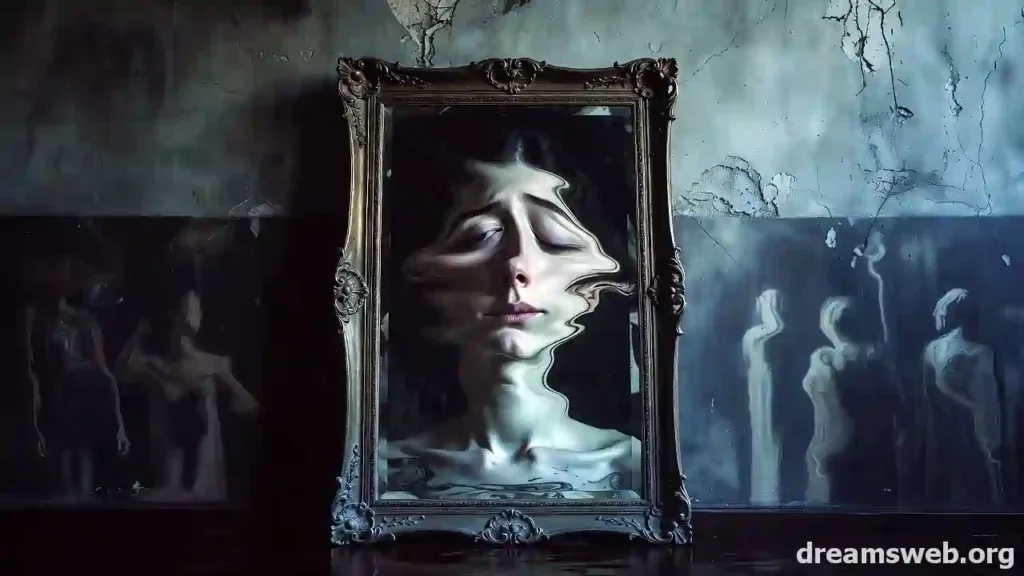
Have you ever awakened from a slumber, heart pounding, after gazing into a mirror in dream where your reflection stared back with alien eyes? This enigmatic phenomenon, where the familiar visage morphs into something uncanny, taps into the deepest recesses of the psyche. Far from mere nocturnal whimsy, such visions unveil profound insights into our subconscious fears, desires, and unresolved quandaries. In this exploration, we delve into the labyrinthine world of oneiric mirrors, dissecting why your dream reflection often defies reality and what it signifies for your waking life.
Why Mirrors in Dreams Look Distorted or Wrong
In the ethereal realm of somnolence, mirrors seldom function as impartial reflectors. Instead, they warp and contort, presenting a reflection that feels dissonant from your corporeal self. This distortion arises from the brain’s nocturnal processing, where the fusiform gyrus—the neural hub for facial recognition—operates in a desynchronized state. During REM sleep, the mind reconstructs visages from fragmented memories, leading to eidolon-like apparitions that evoke unease.
Consider the liminal quality of dreams: they exist betwixt consciousness and oblivion, rendering mirrors as portals to the id. A mirror in dream might elongate features or blur contours, symbolizing perceptual instability. Psychoneurologists posit that such anomalies stem from the amygdala’s hyperactivity, amplifying emotional residues from diurnal experiences. If you’ve encountered a fractured dream reflection, it could signify cognitive dissonance, where internal conflicts manifest as visual aberrations.
This phenomenon isn’t isolated; anthropological studies reveal cross-cultural archetypes of distorted mirrors in folklore, from Japanese yokai tales to European doppelgänger myths. These narratives underscore a universal trepidation: the fear that our reflection conceals a shadowed alter ego. In modern parlance, it’s akin to a glitch in the matrix of self-perception, prompting introspection on authenticity.
Hidden Meaning of Seeing a Strange Face in Mirror
Encountering an unfamiliar countenance in a mirror in dream often heralds a confrontation with the repressed self. This strange face, an oneiric chimera, embodies facets of personality sequestered from waking awareness. Jungian analysts term this the “persona inversion,” where the reflection transmutes into a harbinger of unacknowledged traits—be they virtuous or venal.
Delve deeper: if the alien visage exudes malice, it may mirror latent animosities or unresolved traumas. Conversely, a benevolent stranger could signify untapped potentials, urging self-actualization. Semioticians interpret this as a signifier of identity flux, where the dream reflection disrupts the semiotic chain of self-recognition, fostering existential inquiry.
Historical precedents abound; in ancient Egyptian dream papyri, mirror visions presaged transformations, akin to the ka (soul double) manifesting. Today, neurophenomenology links this to mirror neuron misfires, where empathy circuits project external influences onto one’s image. Such dreams compel us to interrogate: is this stranger a foe or a forgotten ally within?
What Your Dream Reflection Really Reveals About You
Your dream reflection serves as a psychopomp, guiding you through the subconscious labyrinth. It unveils verities obscured by ego defenses, revealing vulnerabilities or aspirations. For instance, a faded mirror in dream might denote diminished self-esteem, while a radiant one augurs burgeoning confidence.
Epistemologically, this reflection embodies the Cartesian doubt of self-knowledge—questioning the veracity of perception. In therapeutic contexts, dream journals illuminate patterns: recurring distortions often correlate with stressors, like imposter syndrome or relational discord. By decoding these symbols, one accesses the noetic core, fostering personal evolution.
Cultural lenses enrich interpretation; in shamanic traditions, the dream reflection is a spirit guide, imparting wisdom through metamorphosis. Psychometrically, tools like the Rorschach test parallel this, where ambiguous forms elicit projections. Ultimately, your mirror in dream isn’t deceitful—it’s a candid oracle, disclosing the multifaceted self.
Distorted Mirror Dream? Signs of Insecurity & Shadow
A contorted mirror in dream frequently signals subterranean insecurities, manifesting as the Jungian shadow—the repository of disowned attributes. This distortion acts as a mnemonic device, recalling suppressed anxieties that erode self-assurance. Signs include asymmetrical features, symbolizing imbalance, or opacity, denoting obscured self-insight.
The shadow archetype, per analytical psychology, integrates these elements for wholeness. A warped dream reflection thus invites shadow work: confronting fears of inadequacy or rejection. Somatopsychic theories suggest bodily sensations during such dreams—palpitations or vertigo—amplify this, linking physical unease to psychic turmoil.
In clinical vignettes, patients with body dysmorphic disorder report amplified distortions, underscoring the interplay between psyche and soma. To mitigate, mindfulness practices recalibrate perception, transforming the reflection from adversary to ally. Recognize these signs as catalysts for growth, not omens of frailty.
Psychological Reasons Mirrors Fail in Your Dreams
The malfunction of mirrors in reverie stems from neurocognitive mechanisms. During hypnagogic states, the dorsolateral prefrontal cortex—governing logic—diminishes activity, allowing surrealism to prevail. This explains why a mirror in dream defies physics, presenting inverted or absent reflections.
Freudian exegesis views this as the superego’s lapse, unleashing id-driven distortions. Behaviorally, it’s conditioned by waking mirror interactions; habitual self-criticism begets nightmarish visages. Cognitive dissonance theory posits that unresolved paradoxes—ethical dilemmas or identity crises—manifest as reflective anomalies.
Neuroimaging corroborates: fMRI scans during lucid dreaming show aberrant activation in the temporoparietal junction, disrupting self-other differentiation. Thus, the failing dream reflection isn’t capricious; it’s a barometer of mental equilibrium, urging recalibration.
Dream Mirror Changes: Spiritual & Jungian Secrets
Transmutations in a mirror in dream harbor esoteric profundities, per spiritual paradigms. In esoteric traditions, mirrors are scrying tools, portals to akashic records. A changing reflection might signify karmic evolutions or astral projections, where the soul glimpses alternate timelines.
Jung’s synchronicity principle elevates this: coincidental dream mirrors align with waking epiphanies, fostering individuation. Alchemical symbolism equates the dream reflection to the prima materia—raw psyche transmuted into gold. Hermeticists interpret distortions as veils lifting, revealing the anima or animus.
Contemporary mysticism integrates quantum entanglement analogies: the mirror in dream entangles observer and observed, collapsing realities. These secrets beckon spiritual seekers to meditate on reflections, unlocking transcendent insights.
Scary Mirror Dreams – What Your Subconscious Hides
Terrifying encounters with a mirror in dream unearth subterranean horrors, the subconscious’s crypt of phantasms. These nightmares, replete with grotesque reflections, expose primal fears—mortality, loss of control, or existential void. The uncanny valley effect intensifies this, where near-human visages evoke revulsion.
Psychodynamically, they represent the return of the repressed: traumas resurfacing as spectral doppelgängers. Thanatological undertones prevail; a shattering dream reflection symbolizes ego dissolution. To decipher, employ gestalt therapy, dialoguing with the apparition to unveil hidden motivations.
Cultural horror tropes—Bloody Mary legends—amplify collective unconscious resonances. Yet, these scary dreams aren’t punitive; they’re purgative, expelling psychic toxins for renewal.
FAQ: Common Questions About Mirror Dreams Answered
What Does It Mean If I Can’t See My Reflection in a Dream?
Absence of a reflection in a mirror in dream often denotes identity erosion or depersonalization. This void mirrors existential voids, prompting soul-searching. Therapeutically, it signals dissociation; journaling aids reconnection.
Why Do Mirrors Break in My Dreams?
A fracturing mirror in dream portends upheaval or fragmented self-perception. Superstitiously, it echoes seven years’ misfortune, but psychologically, it’s cathartic—shattering illusions for rebirth. Analyze contextual emotions for precise meanings.
Is Seeing a Deceased Loved One in a Dream Mirror Significant?
Such visions in a dream reflection facilitate grief processing or spiritual communion. They embody unresolved bonds, offering closure. Mediumistic interpretations view them as interdimensional messages, urging honoring legacies.
How Can I Control Mirror Dreams for Personal Growth?
Lucid dreaming techniques empower manipulation of the mirror in dream. Affirmations pre-sleep foster positive reflections, while therapy integrates insights. Regular meditation enhances oneiric agency, transforming dreams into growth conduits.
In conclusion, the enigmatic mirror in dream transcends mere illusion, serving as a conduit to the psyche’s depths. By heeding its messages, we navigate toward self-mastery, where the reflection aligns with our truest essence.



Leave a Reply