
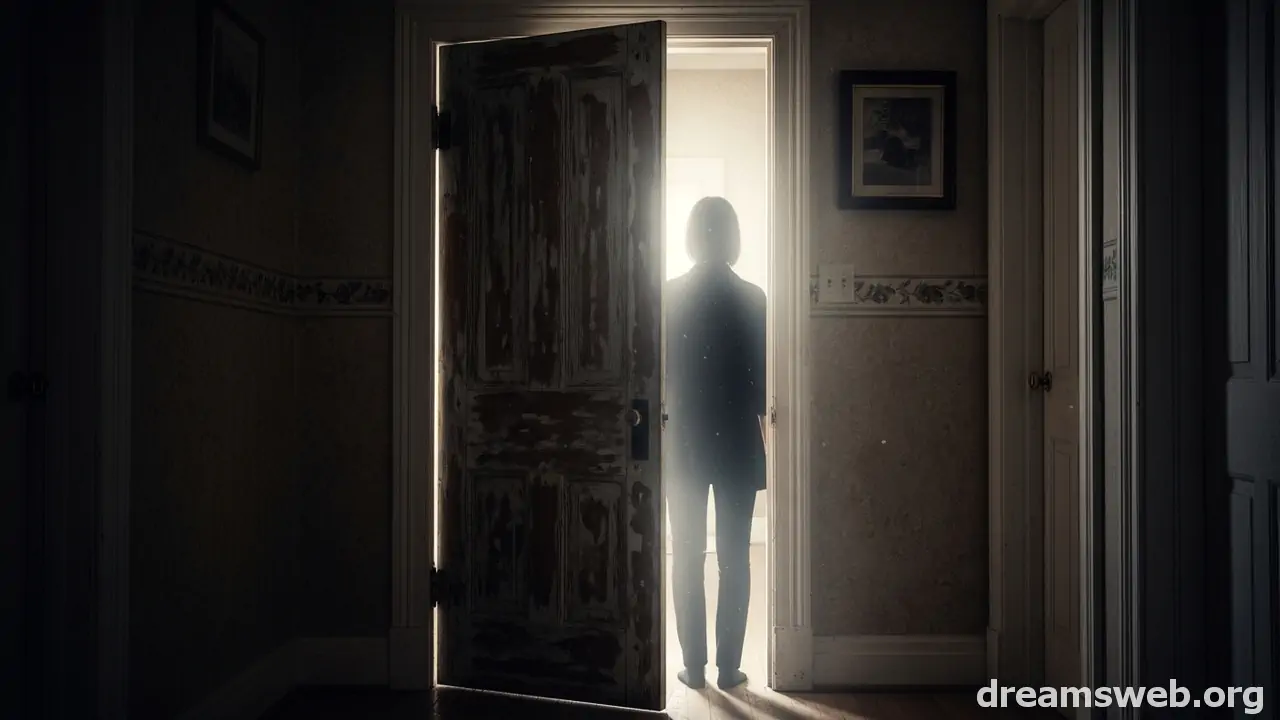
Dreaming of someone waiting at your door reflects unresolved emotional anticipation, a subconscious boundary dilemma, or an inner readiness for change that has not yet been acted upon. The figure at the threshold rarely represents the person themselves — it represents something your waking mind has not yet decided to let in, or let go of.
You wake from it without fully understanding why it stayed with you. The image is quiet, even unremarkable on the surface — someone standing at your door. Waiting. Maybe they are still. Maybe they knocked once, long ago. Maybe you can see the silhouette through frosted glass, motionless and patient, and for reasons you cannot explain, you hesitate to open the door.
Dreams like this have a particular quality. They do not frighten you in the way nightmares do. They unsettle you in a subtler register — the kind that lingers through a morning cup of coffee and resurfaces at odd, unguarded moments. That persistence is the dream’s way of telling you it carries something worth examining.
This article unpacks that image carefully — not through superstition or vague generalities, but through the lens of psychological symbolism, subconscious processing, and the rich body of oneiric (dream-related) research that illuminates why the sleeping brain reaches for this particular scene.
What Your Brain Is Processing When This Dream Appears
To understand why you dream of someone waiting at your door, it helps to first understand what the dreaming brain is actually doing while you sleep. During REM sleep — the phase most associated with vivid, narrative dreaming — the brain is not resting. It is actively consolidating memory, processing emotional residue from the day, and constructing scenarios that help it work through unresolved psychological tension.
The imagery it selects is never accidental. The sleeping mind operates as a symbol-generator, reaching into the storehouse of personal experience and universal archetypes to find images that most accurately capture what needs to be felt or understood. A door — and a figure waiting behind it — is among the most symbolically dense scenes it can construct.
Neurologically speaking, the amygdala (the brain region most associated with emotional processing and threat detection) remains highly active during REM sleep. This means dreams are not only emotionally vivid — they are emotionally purposeful. When you dream of someone waiting at your door, the brain is often rehearsing an emotional situation: anticipation, ambivalence, reluctance, or longing. The scene at the threshold externalises an internal state that your waking consciousness may not have fully named yet.
The dream does not create the feeling. It reveals what was already there, waiting in the corridors of the subconscious mind.
Common psychological triggers for this dream include: a pending decision you have been postponing, a relationship whose direction feels unclear, an opportunity that arrived before you felt ready, or suppressed emotions about someone from your past or present life. The figure at the door is a vessel for all of it.
The Psychology Behind Doors as Recurring Dream Symbols
In the lexicon of dream symbolism, doors are liminal objects — they exist at the boundary between one state and another. Psychologist Carl Jung regarded thresholds in dreams as potent indicators of psychological transition. A door does not simply represent an entrance or exit. It represents the very act of choosing — to cross, to remain, to open, or to keep closed.
In dreams, the house itself is widely understood to represent the self — the full inner architecture of identity, memory, emotional life, and personal boundaries. Just as each room in a dream house can correspond to a different aspect of the psyche, the front door holds particular significance. It is the interface between the private interior self and the external world. It governs who and what is permitted to enter.
When someone appears waiting at that door in a dream, the symbolism deepens considerably. The figure is not merely a visitor — they are a representation of something seeking access to your inner world. That could be an emotion you have been suppressing, a relationship dynamic asking for acknowledgment, a part of your own psyche that has been standing in the wings, waiting for permission to be seen.
The door as a boundary between the known and unknown self
One of the most useful frameworks for understanding the dreaming door comes from the Jungian concept of the threshold — the psychological borderland between the ego (the conscious self you know) and the unconscious (the vast, unexamined interior that dreams inhabit). When something stands at your door in a dream, it often embodies what Jung called the shadow: the collection of traits, emotions, and experiences that have been disowned, minimised, or simply left unprocessed.
This is why the figure at the door can feel simultaneously familiar and strangely threatening, or familiar and unexpectedly tender. It is not a stranger in the truest sense. It is a part of you, wearing a face your sleeping mind selected from its archive.
This dream also connects naturally to the broader experience of house-related imagery. If you have ever had a dream about a house on fire, you will recognise the same underlying mechanism — the dreaming brain using the architecture of a home to map the landscape of the inner self, and signalling emotional pressure through what happens at or within that structure.
What It Means When a Stranger Waits at Your Dream Door
When the figure at your door is someone you do not recognise — an unknown face, a featureless silhouette, or a presence whose identity shifts each time you look — the interpretation follows a specific psychological pathway. Strangers in dreams are among the most symbolically rich figures the subconscious produces. They are rarely random. They are almost always projections.
In Jungian dream analysis, the unknown figure represents an unconscious content seeking admission into conscious awareness. This could be an emotion you have not yet named, a tendency in yourself you have not acknowledged, or a possibility your rational mind has been reluctant to entertain. The stranger at the door is not someone from the external world knocking to be let in — they are an emissary from the interior.
When the stranger feels threatening versus neutral
The emotional colouring of the dream matters enormously here. If the stranger waiting at your door produces a sense of dread or menace, the dream is likely processing anxiety about something in your waking life that feels intrusive or destabilising — perhaps a situation whose outcome you cannot control, or a relationship that has begun to feel unsafe. The perceived threat is the feeling looking for form.
If, on the other hand, the stranger waiting at your dream door carries a neutral or even quietly significant presence — patient, still, unhurried — the dream has a softer, more invitational quality. This variation tends to emerge during periods of personal transition or emerging self-awareness, when something new in yourself is ready to be acknowledged but you have not yet opened the door to it consciously.
The question the dream poses is not “who is this person?” It is: “what am I not yet willing to let in?”
What It Means to Dream of Someone Familiar at the Door
When the person waiting at your door is someone you recognise — a friend, a former partner, a family member, or a colleague — the symbolic register shifts. Known figures in dreams often function as mirrors. They reflect not just the relationship you share with them in waking life, but specific emotional threads that remain unresolved or unspoken between you.
If an ex-partner is the one standing at your door, the dream is rarely about that person specifically. More often, it is processing the residual emotional weight of that chapter — the parts that were not cleanly closed, the feelings that never quite reached a full conclusion. The figure stands at the threshold because the internal work of that relationship has not been completed, regardless of whether you are in contact with them in waking life or not.
A deceased person waiting at your door
Among the most emotionally affecting variations of this dream is when the person waiting outside is someone who has passed away. Grief researchers and dream analysts alike have documented the high frequency of visitation dreams following bereavement. In these cases, the dreaming mind constructs an encounter that serves the psychological work of mourning — allowing a form of continued connection, a chance to process unspoken words, or simply the emotional experience of proximity once more.
A deceased person standing patiently at your door in a dream rarely carries an ominous quality. More commonly, it is tender — suffused with a yearning that the waking mind manages by suppressing. The dream creates the space that waking life no longer provides.
Someone from your present life standing at the threshold
When the figure is a person currently in your life — a friend you have been emotionally distant from, a family member with whom things are unresolved, or someone you have been meaning to reach out to — the dream is often a reflection of interpersonal ambivalence. Part of you wants the connection. Part of you is not sure yet whether to open the door. The dream externalises that internal negotiation precisely, placing the figure at the exact symbolic location where it belongs.
How Your Emotions in the Dream Shift the Interpretation
If there is a single variable that most dramatically shapes the meaning of dreaming of someone waiting at your door, it is the emotional atmosphere of the dream itself. Two people can dream an almost identical scene — a figure, a door, a moment of hesitation — and carry entirely different messages, simply because the emotional textures diverge.
Consider the following emotional signatures and what they commonly indicate:
Fear or dread: When the figure at the door produces a visceral sense of threat, the dream is drawing on anxiety already present in waking life. Something external is pressing on your sense of safety or personal boundary. The figure embodies the pressure, not the specific source.
Guilt or avoidance: If you feel, in the dream, that you should open the door but find yourself unable or unwilling to do so — hiding, pretending not to be home — this is among the clearest emotional signatures of procrastination or avoidance in your waking life. There is something you know needs attending to that you have been deferring.
Longing or warmth: When the figure outside carries a quality of warmth, and the dream has a quality of tender anticipation, the interpretation tilts toward readiness. You are being shown something your subconscious is already preparing to welcome — a new relationship, a new identity, a possibility you have been circling without committing to.
Calm or neutrality: A figure who waits without urgency, and a dreamer who observes without distress, often signals a dream of integration — the psyche is taking inventory of something unresolved without emotional alarm. This is often a sign of psychological maturity working quietly in the background.
The sleeping mind does not exaggerate. When it places something at the threshold, it has already assessed it as worthy of your attention.
Does This Dream Signal Unresolved Feelings or Anxiety?
This is perhaps the question most commonly brought to this type of dream: is the anxiety you feel in the dream a sign of something wrong, or is it simply a normal byproduct of the emotional content being processed?
The honest answer is that dreaming of someone waiting at your door is almost never a sign of pathology or external danger. It is, in the vast majority of cases, a very normal response to the emotional complexity of being human. We all carry unfinished relational business. We all hesitate at certain thresholds. We all have interior aspects of ourselves that knock, again and again, waiting for an invitation inward.
What the dream is flagging — when it recurs, or carries particular emotional intensity — is that something in the unresolved category deserves more conscious attention than it is currently receiving. The sleeping brain, denied the ability to act directly on the situation, constructs a scene where the unresolved content is represented as vividly as possible. It places it at your door and asks you, in the only language it has: what are you going to do?
When this dream becomes recurrent
A dream that visits once may be processing an isolated emotional event. A dream that returns repeatedly — the same figure, the same door, the same hesitation — is a signal of persistence from the subconscious. Something has not been adequately addressed in waking life, and the dreaming mind continues to stage the same symbolic scene until the underlying situation receives attention.
Recurrent threshold dreams often accompany periods of sustained avoidance: a conversation that keeps being postponed, a decision that keeps being deferred, a feeling that keeps being pushed aside in favour of daily urgency. The dream is not patient with this indefinitely. It keeps returning to the door, keeps placing the figure there, keeps asking.
Spiritual and Cultural Meanings of a Door Visitor Dream
Across human history and across vastly different cultural frameworks, the image of a figure waiting at a threshold has carried profound symbolic weight. This cross-cultural resonance suggests that the dream taps into something deeper than individual psychology — something closer to a shared symbolic inheritance.
The Abrahamic tradition
In Biblical symbolism, the door is one of the most theologically loaded images in scripture. The Book of Revelation includes the passage where Christ stands at the door and knocks, waiting for the inhabitant to open — a metaphor for spiritual receptivity and the act of choosing to receive divine presence. In this framework, the figure at the dream door carries an invitational rather than threatening quality: the question is not whether to fear it, but whether you are willing to open the door.
Islamic dream interpretation, which has a long and sophisticated tradition dating back to the scholarship of Ibn Sirin, treats door imagery in terms of tawakkul — trust and reliance. A figure waiting patiently at a door may be interpreted as a sign of a significant life transition approaching, or a blessing whose arrival depends on the dreamer’s willingness to receive it.
Eastern philosophical traditions
In Hindu and Buddhist frameworks, thresholds carry karmic significance. The figure at the dream door may represent a soul with whom unresolved karma exists — a relationship that calls for resolution, forgiveness, or conscious acknowledgment before the dreamer’s own inner journey can progress. From a Buddhist standpoint, the figure waiting patiently may embody an aspect of the dreamer’s awareness that has reached a state of readiness but cannot proceed without the dreamer’s conscious participation.
This resonates naturally with the psychological reading — the outer figure and the inner content are, in many traditions, understood as the same thing wearing different cultural garments.
Common Variations of This Dream and What They Reveal
The core scene — a figure, a door, a state of waiting — produces many distinct variations, each of which carries its own interpretive nuance. Understanding these subtypes can help a dreamer identify which version most closely matches their own experience and therefore which interpretation is most likely to resonate.
You see the person but do not open the door
This is perhaps the most psychologically significant variation. The act of seeing but not opening — holding position behind the door, watching through the glass, or simply remaining still — speaks directly to conscious avoidance. You know the figure is there. Some part of you recognises it. And yet, you do not open. This variation tends to surface most forcefully during periods of deliberate emotional postponement.
You open the door and no one is there
When you finally gather the will to open the door in the dream and find the threshold empty, the dream is processing disappointment, missed timing, or the grief of an opportunity or connection that has passed. It is sometimes associated with the emotional aftermath of a relationship that ended before its natural resolution, or with the feeling of having acted too late on something that mattered.
The person at the door is waiting in the dark
Darkness in dreams amplifies the unknown quality of whatever appears within it. A figure waiting in darkness at your door combines the boundary-testing symbolism of the threshold with the psychological uncertainty of the unlit, unexamined space. This variation often corresponds to fears or feelings that remain largely unconscious — something the dreamer senses but has not yet brought fully into the light of waking awareness.
Multiple people waiting at the door
When several figures stand waiting, the dream’s emotional weight multiplies accordingly. This variation frequently emerges during periods of social overwhelm, relational complexity, or situations where multiple competing demands or relationships are pressing simultaneously for the dreamer’s attention and response. The house cannot hold them all, and the dreamer must decide who — and what — deserves to be let in first.
Dreams that involve the home as a central setting often interweave with one another thematically. If you have experienced a dream where the house itself becomes a site of crisis — as in the powerful symbolism of dreaming of a house on fire — it may be worth reading the two experiences together, as both use domestic architecture to map an interior emotional landscape under pressure.
FAQ: Is Dreaming of Someone at My Door a Warning Sign?
Below are the most commonly asked questions about this dream. Click any question to expand the answer.
It typically signals unresolved emotional anticipation or a subconscious prompt to address something you have been avoiding — represented as a figure your dreaming mind placed at the threshold of your inner world.
Rarely. Most door-visitor dreams reflect inner emotional states rather than external threats. The emotional tone of the dream — fear, calm, or curiosity — is usually the most accurate indicator of what the subconscious is processing.
A recurring stranger at your door often symbolizes an unacknowledged aspect of yourself. The repetition suggests the subconscious is persistently drawing your attention toward a trait, emotion, or possibility you have not yet integrated.
The known figure often mirrors something unresolved — unspoken feelings, pending decisions, or emotional weight still attached to the relationship, whether that bond is current or belongs to the past.
Across several traditions, a figure waiting at a dream door carries spiritual resonance — representing divine invitation, karmic readiness, or a soul-level prompt to open yourself to something your conscious awareness has been reluctant to receive.
Dreams are deeply personal, and no single interpretation applies universally. The most resonant reading is always the one that connects honestly to your current circumstances and emotional life. Use this analysis as a starting point, not a conclusion.

Leave a Reply