

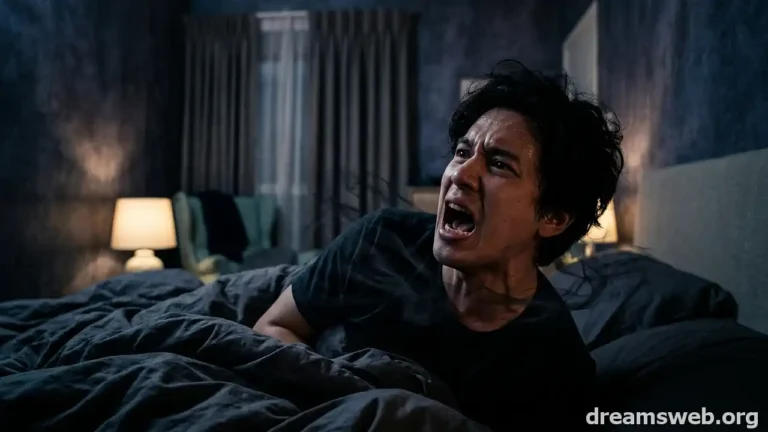
You open your mouth. Something is wrong — terribly, urgently wrong — and every part of you wants to cry out. Your lungs fill, your throat tightens, your face contorts with the effort. But what comes out is nothing. Not a whisper. Not even air. Just a terrible, pressured silence where the scream should be.
Then you wake up.
If you have had this experience — the recurring silent scream dream — you know exactly how disorienting the aftermath feels. You lie in the dark with your pulse thudding, wondering why your own voice disappeared at the moment you needed it most. The dream dissolves but the residue stays. A quiet unease. A question you cannot quite form.
This kind of dream is not rare. It surfaces across cultures, across age groups, across wildly different life circumstances. And yet most people who experience it feel oddly alone in it — as if this particular loop of helplessness is theirs alone to carry.
It is not. And it is not random, either.
What Happens in Your Brain During a Silent Scream Dream
To understand the silent scream dream, it helps to briefly look at what the sleeping brain is actually doing.
During REM sleep — the stage in which most vivid dreaming takes place — your brain is firing with intense activity. The limbic system, which governs emotion, is highly engaged. The prefrontal cortex, which handles logic and impulse control, is largely offline. This imbalance is part of why dreams feel so emotionally raw and so physically convincing.
At the same time, the motor system undergoes a process called REM atonia. This is a temporary and protective muscular paralysis that prevents the sleeping body from physically acting out whatever the dreaming mind is experiencing. Your arms do not swing when you dream of fighting. Your legs do not run when you dream of fleeing. And — perhaps most relevantly — your vocal cords do not produce sound when you dream of screaming.
So when you try to scream in a dream and nothing comes out, part of what you are experiencing is this: your brain has registered a threat, escalated into panic, and attempted to trigger a vocal response — but the physical infrastructure for that response has been deliberately suppressed by your own neurology.
The dream is not malfunctioning. Your brain is working exactly as it should. What is worth examining is why the threat scenario keeps arriving in the first place.
Why This Dream Keeps Coming Back Night After Night
A single instance of a voiceless nightmare might be nothing more than a byproduct of stress, an unsettled evening, or an unusually vivid sleep cycle. But when the same scenario returns — the same opened mouth, the same absent sound, the same pressing urgency — it has crossed from coincidence into pattern.
Recurring dreams are the mind’s way of flagging unfinished emotional business. Sleep researchers and depth psychologists alike describe them as the psyche’s persistence mechanism — the dreaming brain returning to a scenario again and again until the underlying emotional charge is processed, or until the waking-life situation that generated it changes.
The recurring silent scream dream often accompanies periods in a person’s life when they feel chronically unheard, silenced, or unable to express something important. This does not always look dramatic from the outside. It might be a slow build of unexpressed frustration in a long-term relationship. A workplace dynamic where your input is consistently overridden. A grief that has not been given language. A truth that you have been carrying without anywhere to put it.
The dream encodes the feeling before the conscious mind fully recognizes it. That is what makes it so persistent. You cannot talk yourself out of a recurring dream by deciding it is meaningless. It returns because something in you has not yet been addressed.
This connection between internal silence and repetitive dreaming is closely related to what happens in other recurring anxiety dreams, like dreaming of being late — where the brain constructs urgent, high-stakes scenarios to communicate emotional pressure that has no other outlet during waking hours.
The Emotions Your Sleeping Mind Is Trying to Process
Suppressed Anger and the Throat That Won’t Cooperate
Of the many emotions that can generate a can’t scream in dreams experience, suppressed anger is among the most clinically consistent. Anger that has not been expressed — particularly anger that was deemed too dangerous, too inappropriate, or too destabilizing to voice aloud — often finds its way into the dream state as a kind of phantom vocalization.
The dreamer wants to scream. The scream represents something they have been holding back in their waking life: a confrontation they never had, a boundary they never enforced, a resentment they were taught to swallow. In the dream, the body tries to release it. And it can’t. Because the same learned suppression that operates during the day has embedded itself deeply enough to reach the sleeping mind.
This is not a weakness. It is a portrait. The dream is showing you the shape of something that has been kept very quiet for a very long time.
The Weight of Being Chronically Unheard
There is a distinct quality to the silent scream dream that goes beyond general anxiety. It is specifically about the voice — the most personal instrument of communication a person has. When the voice fails in a dream, the emotional subtext is almost always relational: something in your world is not receiving what you are trying to say.
This could manifest as a feeling that your concerns are consistently minimized. That your emotional responses are treated as disproportionate or inconvenient. That you speak, but the words land somewhere without weight. Dreams are not subtle about this. They make the silence literal, physical, and terrifying — precisely because that is how the emotional experience of being unheard actually feels.
Grief With No Language
Grief is another consistent generator of voiceless dream states. Particularly grief that has been privatized — loss that was processed alone, or loss for which the social context did not allow adequate mourning. The scream that cannot be released in a dream may represent not rage, but sorrow that has been compressed inward for too long.
Is Your Body Actually Doing Something While You Dream?
This is a question worth addressing plainly, because the physical sensation of trying to scream in a dream can be so vivid that people sometimes wonder if they are actually making sounds in their sleep.
For most dreamers, the answer is no. The REM atonia mechanism keeps vocal expression suppressed during the dream state. A partner or roommate sharing your sleep space would typically notice nothing unusual. You are not screaming silently into the physical room — you are screaming silently into the neural architecture of your own sleeping brain.
There is, however, an adjacent phenomenon worth distinguishing from the standard recurring silent scream dream: sleep paralysis. In sleep paralysis, a person wakes — or partially wakes — while still in a state of REM atonia. They are conscious enough to register their surroundings but unable to move or speak. This experience, often accompanied by vivid and frightening hallucinations, shares some of the same quality of voiceless helplessness. But it is neurologically distinct from an ordinary nightmare.
If you have experienced what felt like waking mid-scream and being unable to produce sound, that is more likely a sleep paralysis episode than a dream. Both deserve attention. Both are worth tracking over time.
The experience of bodily betrayal during sleep — whether it is trying to flee something unseen or trying to call for help — is a theme that runs through many categories of recurring nightmares. It is not entirely unrelated to dream experiences where something pursues you and your body cannot respond the way it should.
What Psychologists Say About Voiceless Nightmare Patterns
Clinical literature on recurrent nightmares tends to frame them not as glitches but as communications. The psychologist Ernest Hartmann, who spent decades studying nightmare function, described recurring dreams as organized around a central image — a vivid, emotionally charged symbol that concentrates a particular feeling the dreamer is processing.
In the voiceless nightmare, the central image is the failed scream. And according to Hartmann’s framework, that image would represent the dreamer’s most condensed emotional concern — the thing they most need to say and most fear cannot be said.
From a cognitive-behavioral perspective, recurring nightmares are also understood as learned fear responses. The dream scenario activates the brain’s threat-detection systems, the systems respond with the appropriate physiological arousal, and over time the association between sleep and that particular panic-state becomes entrenched. The brain has essentially rehearsed the nightmare until it runs smoothly.
This is why simply wanting the dream to stop is usually insufficient. The neural pathway that generates it is well-worn. Changing it requires either addressing the waking emotional source or, in clinical settings, using evidence-based techniques specifically designed to rewrite dream content.
Hidden Stress Triggers That Fuel Recurring Dream Loops
Not all of the emotional content driving a recurring nightmare meaning is dramatically obvious. Sometimes the triggers are quieter, more cumulative, and harder to identify precisely because they have become normalized.
Chronic low-grade stress — the kind that builds across weeks or months without a single identifiable crisis — is one of the most common underpinning conditions for recurring nightmare patterns. The waking brain adapts to it. The sleeping brain, which processes emotional material with less filtration, continues to register the accumulated weight.
Some specific life conditions that frequently correlate with the silent scream dream pattern include:
Vocational dissatisfaction — particularly situations where a person feels that their competence, judgment, or contributions are not recognized or respected. The professional silence translates, in the dream, to a literal one.
Relational power imbalance — dynamics in which one person’s emotional reality is consistently subordinated to another’s. The dream externalizes the internal pattern.
Identity suppression — circumstances in which a person has been living out of alignment with their own values, desires, or self-understanding, often for the sake of social acceptance or safety.
Unresolved traumatic memory — particularly memories involving situations where speaking out was not safe, was punished, or simply went unresponded to.
The dream does not always point to a single cause. More often, it reflects a layering of these conditions over time.
When the Silent Scream Dream Signals Something Deeper
Most instances of a recurring silent scream dream are the psyche’s natural attempt to metabolize emotional overload. They do not require clinical intervention. But there are circumstances in which the dream — particularly when combined with other symptoms — may be signaling something that warrants more careful attention.
If the silent scream dream is accompanied by significant daytime anxiety, intrusive waking thoughts that feel related to the dream content, physical hypervigilance, or a general sense of emotional numbness outside of sleep, it may be worth speaking with a mental health professional. These symptom clusters can indicate the presence of an anxiety disorder, a trauma response, or a depressive episode that has entered the sleep architecture.
Dreams rarely exist in isolation. They are one thread in a broader tapestry of psychological and physiological experience. When that thread keeps pulling your attention night after night, it is usually because something in the broader fabric needs looking at.
It is also worth noting that the dream may shift in character as waking-life circumstances change. Some people report that their silent scream dream gradually becomes a partial scream — a broken, hoarse sound instead of pure silence — and then eventually, over time, a full-throated one. This progression is not uncommon, and it often correlates with meaningful emotional work done during waking hours. The voice in the dream recovers as the voice in life is recovered.
Breaking the Loop: What Actually Helps Over Time
Giving the Dream Material a Waking Voice
The most consistently useful first step is deceptively simple: write the dream down. Not just the surface events, but the emotional texture — what you were trying to say, to whom, in what situation. The act of translating dream content into language performs some of the same emotional processing that the dream itself was attempting.
Journaling practice around recurring nightmare content has been shown to reduce both the frequency and emotional intensity of those dreams over time. The key is specificity. Not “I tried to scream and couldn’t” but: Who was there? What was the danger? What did I need to say? What was I afraid would happen if I said it?
Image Rehearsal as a Clinical Approach
For those whose recurring nightmare is significantly disrupting sleep quality, Image Rehearsal Therapy — a technique developed by Dr. Barry Krakow — offers a structured and evidence-supported path forward. The practice involves consciously rewriting the dream narrative while awake, then rehearsing the new version mentally each day before sleep.
Over a matter of weeks, many people find that the dream either ceases to recur or shifts into a less distressing form. The brain appears to accept the rehearsed revision as a valid alternative script.
Addressing the Waking Source Directly
No amount of dream work fully replaces addressing the conditions that generate the dream. If the silent scream dream is rooted in a relational dynamic where you consistently feel unheard, the dream is unlikely to permanently resolve until that dynamic is addressed — whether through direct conversation, renegotiation of boundaries, or in some cases, the ending of a relationship or role that no longer serves the person’s wellbeing.
The dream is not the problem. The dream is pointing at the problem. Attending to the pointer and ignoring the problem it indicates will only sustain the loop.
The kind of bodily helplessness that surfaces in dreams — the sense of being unable to act, speak, or protect yourself — also shares thematic territory with dreams about anxiety, loss of control, and self-expression difficulties, which tend to cluster in people navigating similar emotional terrain.
Frequently Asked Questions
Q1: Why can’t I scream in my dreams no matter how hard I try? During REM sleep, your body enters temporary muscle paralysis called REM atonia. This suppresses vocal cord movement, making screaming physically impossible even when your dreaming mind desperately wants to produce sound.
Q2: What does a recurring silent scream dream mean emotionally? It often signals suppressed anger, unexpressed grief, or a chronic feeling of being unheard in waking life. The dreaming mind literalizes the emotional experience of voicelessness into a physically felt, repeating scenario.
Q3: Is the silent scream dream the same as sleep paralysis? Not exactly. Sleep paralysis occurs when you wake mid-REM and cannot move or speak. A silent scream dream happens while fully asleep. Both involve voicelessness but arise through different neurological mechanisms during sleep.
Q4: Can recurring voiceless nightmares be treated or stopped? Yes. Image Rehearsal Therapy, dream journaling, and addressing waking emotional sources are all effective approaches. Most recurring nightmare patterns reduce significantly when the underlying emotional material receives adequate waking-life attention.
Q5: When should I see a professional about my silent scream dream? Seek support if the dream recurs alongside daytime anxiety, intrusive thoughts, emotional numbness, or disrupted sleep. These combined symptoms may indicate a trauma response or anxiety disorder that benefits from professional therapeutic care.
A Final Thought
The recurring silent scream dream is not a failure of your sleeping mind. It is a persistence of something in you that has not yet found its waking voice. The silence in the dream is not the end of the conversation. It is, in a way, the beginning of one — a quiet, insistent invitation to ask yourself what you have been carrying without saying, what you have been waiting to speak, and who in your life might finally be ready to hear it.
The voice is still there. The dream is proof of that. It keeps trying.
📢 Have you been experiencing this dream? If the silent scream dream has been visiting you regularly, take a moment to explore our other deep-dive interpretations. Understanding the emotional language of your sleep is one of the most direct paths to understanding yourself. Browse more dream meanings on DreamsWeb — no sign-up, no paywalls, just honest insight.
#can't scream in dreams #recurring nightmare meaning #silent scream dream #voiceless nightmare causes⚠️ Disclaimer: This article is written for informational and educational purposes only. It does not constitute clinical advice, psychological diagnosis, or medical guidance of any kind. If you are experiencing significant sleep disturbances, persistent nightmares, or symptoms of anxiety or trauma, please consult a qualified mental health professional. Dream interpretation frameworks presented here draw on psychological literature and should not replace professional therapeutic support.


